CivAgent 系列(七):跨学科桥梁、技术实现与认识论反思 CivAgent Series (VII): Interdisciplinary Bridges, Technical Implementation, and Epistemological Reflections
「世界历史可以这样总结:当国家强大时,它们并不总是公正的;而当它们希望做到公正时,它们往往已不再强大。」 —— 温斯顿·丘吉尔
系列导航:一:问题的提出 · 二:六种编排模式 · 三:唐代三省六部 · 四:明代双轨制 · 五:雅典民主 · 六:波斯总督制 · 七:理论与实现
系列的最后一篇。前六篇完成了从问题提出到案例分析的论证链。本篇搭建跨学科的理论桥梁、介绍 CivAgent 的技术实现,并反思历史学在 AI 时代的三重独特价值。
一、跨学科的理论桥梁
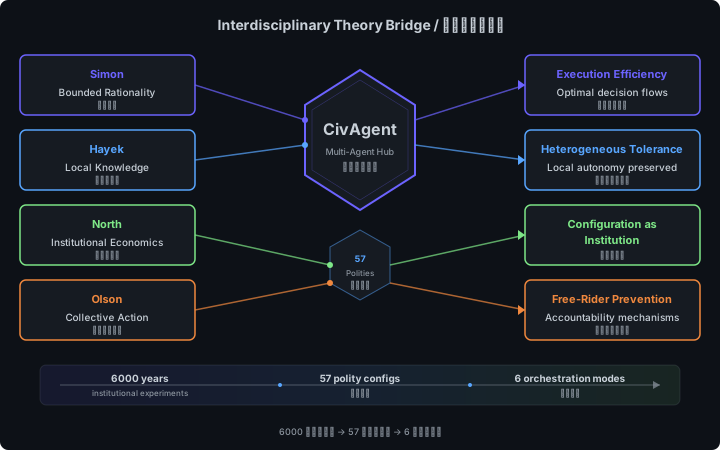
1.1 有限理性与制度设计
赫伯特·西蒙在《管理行为》(1947)中提出的「有限理性」(bounded rationality)概念[1]可以完美解释为什么不同的政体在不同情境下各有优劣——没有一个 Agent(或人类决策者)能够获得完全信息并做出最优决策,因此制度设计的核心就是在信息不完全的约束下,设计出最有效的决策流程。
| 信息特征 | 最适编排模式 | 历史例证 | 理论依据 |
|---|---|---|---|
| 信息集中、决策紧急 | 中央集权 | 秦统一战争 | Tilly: 强制力集中[2] |
| 信息复杂、需多角度审核 | 制衡 | 唐代政务 | Coase: 审核降低错误成本[3] |
| 信息分散、各区域差异大 | 联邦 | 波斯帝国 | Hayek: 地方知识[4] |
| 信息需聚合、高不确定性 | 民主议会 | 雅典战略决策 | Ober: 分布式知识[5] |
| 需双重独立验证 | 双轨 | 明代政务 | Avizienis: N-version[6] |
| 信息稀缺、需快速行动 | 神权 | 商代军事 | 随机化打破僵局 |
1.2 哈耶克的地方知识论
哈耶克在 1945 年的经典论文《知识在社会中的利用》中提出[4]:社会中最重要的知识不是科学知识,而是「特定时间和地点的知识」——这些知识分散在无数个体手中,任何中央计划者都无法收集齐全。因此,最好的制度设计是让知识在产生的地方被使用,而不是强行汇集到中央。
这为联邦模式和民主议会模式提供了强有力的理论支持:波斯帝国的总督制让「地方知识」在地方被使用;雅典的民主制让「分散的知识」在公民大会上被聚合。
1.3 制度经济学:制度作为约束
道格拉斯·诺斯在《制度、制度变迁与经济绩效》(1990)中指出[7]:制度是人类设计的约束,用来塑造人际互动。 制度包含三个层次:
| 诺斯的制度概念 | CivAgent 配置 | 作用 | 变更频率 |
|---|---|---|---|
| 非正式约束(文化规范) | SOUL.md |
定义 Agent 的行为准则、语言风格 | 极低 |
| 正式规则(法律、宪法) | IDENTITY.md |
定义角色权限、决策流程 | 低 |
| 执行机制(法庭、警察) | openclaw.json |
定义通信规则、超时处理 | 中 |
诺斯的一个关键洞见是路径依赖(path dependence)[7]:一旦选择了某种制度路径,转换到另一条路径的成本随时间递增。在 AI 编排中同样成立:一旦选择了某种 Agent 架构,围绕它构建的 prompt、workflow、监控系统都会产生切换成本。因此架构选择的初始决策极其重要——这正是 CivAgent 试图提供的价值。
1.4 博弈论视角:搭便车问题
奥尔森在《集体行动的逻辑》(1965)中揭示了集体行动的基本困境[8]:理性的个体往往不会为集体利益而行动。不同的政体用不同的方式解决这个问题:
| 模式 | 解决策略 | AI 编排等价物 |
|---|---|---|
| 集权 | 强制(秦的连坐制) | 严格输出格式和验证规则 |
| 制衡 | 制度化激励(唐的科举) | 交叉审核 |
| 民主 | 参与感(雅典投票) | 所有 Agent 输出公开透明 |
| 联邦 | 退出权(波斯的地方自治) | Agent 保留自主决策权 |
在 AI 编排中,「搭便车」的等价问题是Agent 偷懒——返回低质量输出以节省 token/计算。不同编排模式提供了不同的对策。
二、CivAgent 的技术实现
2.1 架构设计决策
CivAgent 基于 OpenClaw 框架构建。核心的工程决策是:政体作为纯配置,而非代码。
每种文明由 5 个配置文件组成:
| 文件 | 作用 | 制度学对应 | 格式 |
|---|---|---|---|
metadata.json |
机器可读的元数据 | 政体分类学编码 | JSON |
openclaw.json.template |
Agent 配置模板 | 正式制度规则 | JSON |
SOUL.md |
行为准则与语言风格 | 非正式文化规范 | Markdown |
IDENTITY.md |
组织架构图与角色映射 | 官僚体系设计 | Markdown |
README.md |
历史背景与使用说明 | 制度史文献 | Markdown |
为什么选择「配置而非代码」?因为这直接映射了诺斯的制度理论[7]:
- 改变代码 = 技术革命(需要重新编译、部署,风险高,等价于「改朝换代」)
- 改变配置 = 制度改革(只需替换配置文件并重启,风险可控,等价于「变法」)
2.2 切换政体
实际操作中,切换政体就是一行命令:
./scripts/switch-regime.sh china/ming # 从当前政体切换到明制
脚本会自动:
- 备份当前的配置文件(保存「旧制」以备回滚)
- 部署新政体的配置文件
- 保留用户的 API Key 和 Bot Token(「改制不改人」)
2.3 覆盖范围
20 个中华朝代(从夏 c.2070 BC 到太平天国 1864):
| # | 朝代 | 时代 | 编排模式 | Agent 数 |
|---|---|---|---|---|
| 1 | 夏 | c.2070-1600 BC | 族长集权 | 5 |
| 2 | 商 | c.1600-1046 BC | 神权 | 6 |
| 3 | 周 | c.1046-256 BC | 联邦 | 8 |
| 4 | 秦 | 221-206 BC | 中央集权 | 7 |
| 5 | 汉 | 206 BC-220 AD | 制衡(初期) | 10 |
| 6 | 三国 | 220-280 | 联邦(竞争) | 9 |
| 7 | 晋 | 266-420 | 弱联邦 | 6 |
| 8 | 南北朝 | 420-589 | 联邦(门阀) | 6 |
| 9 | 隋 | 581-618 | 制衡(原型) | 7 |
| 10 | 唐 | 618-907 | 制衡(经典) | 7 |
| 11 | 五代十国 | 907-960 | 联邦(分裂) | 5 |
| 12 | 宋 | 960-1279 | 制衡(极致) | 8 |
| 13 | 辽 | 907-1125 | 双轨 | 6 |
| 14 | 金 | 1115-1234 | 双轨 | 6 |
| 15 | 西夏 | 1038-1227 | 中央集权 | 5 |
| 16 | 元 | 1271-1368 | 中央集权 | 7 |
| 17 | 明 | 1368-1644 | 双轨 | 8 |
| 18 | 清 | 1644-1912 | 中央集权(精英) | 8 |
| 19 | 中华民国 | 1912-1949 | 制衡(五权) | 7 |
| 20 | 太平天国 | 1851-1864 | 神权 | 7 |
37 个世界帝国(从苏美尔 c.4500 BC 到欧盟 1993-至今),覆盖了人类文明的所有主要分支。
2.4 使用示例
# 克隆项目
git clone https://github.com/LeoLin990405/civagent.git
cd civagent

# 浏览所有文明
./scripts/list-regimes.sh

# 按场景选择
./scripts/switch-regime.sh china/tang      # 需要质量审核?用唐制三省制衡
./scripts/switch-regime.sh china/qin       # 需要快速执行?用秦制中央集权
./scripts/switch-regime.sh global/athens   # 需要多角度分析?用雅典民主
./scripts/switch-regime.sh china/ming      # 需要双重验证?用明制双轨
./scripts/switch-regime.sh global/persian  # 需要松耦合?用波斯总督制
./scripts/switch-regime.sh global/venice   # 需要长期稳定?用威尼斯制衡

# 创建自定义文明
./scripts/create-regime.sh global/your-empire
# 然后编辑 5 个配置文件

# 验证配置
./scripts/validate-regime.sh global/your-empire
三、历史学在 AI 时代的三重独特价值
3.1 第一重价值:已验证的设计模式库
软件工程中的「设计模式」(GoF, 1994)[9]总结了面向对象编程中反复出现的解决方案。类似地,人类 5000 年的政治制度史是一部组织架构设计模式库——每种政体都经历了创建、运行、优化、衰败的完整生命周期。
与软件设计模式不同,政治制度的「设计模式」经过了数十年到数百年的实际运行检验:
- 唐代三省六部制运行了约 300 年
- 威尼斯共和制运行了 1100 年
- 罗马共和制运行了 480 年
- 瑞士联邦制运行了 735 年(且仍在运行)
3.2 第二重价值:反直觉发现的来源
历史经常提供违背直觉的发现,纯理论推导难以得出:
发现 1:过度制衡优于不够制衡(威尼斯)。 威尼斯的制衡机制复杂到了总督选举需要 11 轮交替抽签和投票。直觉上效率应该很低。但威尼斯存续了 1100 年,还成为地中海最富有的城市之一[10]。解释:过度制衡消除了「系统性腐败」的可能性。对于长期运行的生产系统,宁可牺牲效率也要确保足够的审核机制。
发现 2:军事效率与民主决策不矛盾(蒙古)。 蒙古帝国——人类历史上最快速的军事扩张——其决策机制不是独裁而是忽里勒台[11]。集中执行和分散决策可以共存。
发现 3:共识要求过高等于没有共识(波兰)。 波兰的 Liberum Veto——任何一个议员都可以否决任何决议——最终导致灭国[12]。一致性阈值的设定不是数学问题,而是权衡问题。
发现 4:制度衰败的速度远快于制度建设(秦、太平天国)。 秦始皇花了十年建立制度,秦朝只维持了 15 年就崩溃了。AI 系统的架构韧性不能只考虑正常运行状态,还必须考虑关键节点失效的场景。
3.3 第三重价值:权衡意识的培养
或许最重要的是,历史学培养了一种深刻的权衡意识——没有完美的制度,只有在特定条件下最适合的制度。
正如钱穆先生所言[13]:「制度本身必须活的存在,不能刻板不变。」
CivAgent 的 57 种政体不是为了找到「最好的」编排模式,而是为了建立一个组织架构的可选项空间——当你面对不同的 AI 任务场景时,可以从人类历史中找到经过时间检验的参考方案。
四、结语与未来方向
AI 多 Agent 系统正在快速发展。2025-2026 年,我们已经看到了 Claude Code 的 Agent Teams、OpenAI 的 Swarm 框架、Google 的 Agent-to-Agent Protocol、OpenClaw 的多 Agent 编排。但「如何编排多个 Agent 的协作」这个问题,人类已经思考了至少 2400 年。
未来方向:
- 量化评估:在标准化的 AI 任务基准上,对比不同编排模式的性能差异(延迟、质量、成本)
- 动态切换:根据运行时的任务特征自动选择最适合的编排模式
- 制度演化模拟:模拟钱穆发现的「迭代演化」模式——让系统根据运行数据自动发现瓶颈并提出改进
- 更多文明:57 种远非穷尽——奥斯曼坦志麦特、日本幕府制、殖民帝国的间接统治,每一次制度变革都是一个新的 CivAgent 配置
CivAgent 的核心假设是:历史不只是过去的事,它是组织智慧的活化石。
如果这个系列激起了你的兴趣——无论你是 AI 工程师、历史爱好者、组织理论研究者还是政治学学生——欢迎 Star、Fork、提 Issue 或贡献新文明。
项目地址:github.com/LeoLin990405/CivAgent
致谢:没有 @wanikua 的 AI 朝廷 项目——首创性地将唐朝三省六部制与 AI 多 Agent 框架结合——就不会有 CivAgent。同时感谢 @L4ntern0 的 oh-my-tang 项目,证明了这个思路可以用不同的技术栈来实现。
参考文献
[1] Simon, H. A. (1947). Administrative Behavior: A Study of Decision-Making Processes in Administrative Organization. New York: Macmillan.
[2] Tilly, C. (1990). Coercion, Capital, and European States, AD 990–1992. Cambridge, MA: Blackwell.
[3] Coase, R. H. (1937). “The Nature of the Firm.” Economica, 4(16), 386-405.
[4] Hayek, F. A. (1945). “The Use of Knowledge in Society.” American Economic Review, 35(4), 519-530.
[5] Ober, J. (2008). Democracy and Knowledge: Innovation and Learning in Classical Athens. Princeton: Princeton University Press.
[6] Avizienis, A. (1985). “The N-Version Approach to Fault-Tolerant Software.” IEEE Transactions on Software Engineering, SE-11(12), 1491-1501.
[7] North, D. C. (1990). Institutions, Institutional Change and Economic Performance. Cambridge: Cambridge University Press.
[8] Olson, M. (1965). The Logic of Collective Action: Public Goods and the Theory of Groups. Cambridge, MA: Harvard University Press.
[9] Gamma, E., Helm, R., Johnson, R., & Vlissides, J. (1994). Design Patterns: Elements of Reusable Object-Oriented Software. Reading, MA: Addison-Wesley.
[10] Lane, F. C. (1973). Venice: A Maritime Republic. Baltimore: Johns Hopkins University Press.
[11] Weatherford, J. (2004). Genghis Khan and the Making of the Modern World. New York: Crown.
[12] Davies, N. (2005). God’s Playground: A History of Poland (Revised ed., 2 vols.). New York: Columbia University Press.
[13] 钱穆 (1952).《中国历代政治得失》. 台北:东大图书. [Qian Mu (1952). Gains and Losses in Chinese Historical Governance. Taipei: Dongda Books.]
[14] Fukuyama, F. (2011). The Origins of Political Order: From Prehuman Times to the French Revolution. New York: Farrar, Straus and Giroux.
[15] Huntington, S. P. (1968). Political Order in Changing Societies. New Haven: Yale University Press.
[16] Mintzberg, H. (1979). The Structuring of Organizations. Englewood Cliffs, NJ: Prentice-Hall.
</small>
“The whole history of the world is summed up in the fact that, when nations are strong, they are not always just, and when they wish to be just, they are no longer strong.” — Winston Churchill
Series Navigation: I: Posing the Question · II: Six Orchestration Modes · III: Tang Dynasty Three Departments · IV: Ming Dynasty Dual-Track · V: Athenian Democracy · VI: Persian Satrap System · VII: Theory & Implementation
The final installment in the series. The preceding six articles completed the argumentative chain from problem formulation to case analysis. This article constructs interdisciplinary theoretical bridges, introduces the technical implementation of CivAgent, and reflects on the three unique values that historiography offers in the age of AI.
I. Interdisciplinary Theoretical Bridges
1.1 Bounded Rationality and Institutional Design
Herbert Simon’s concept of “bounded rationality,” introduced in Administrative Behavior (1947)[1], provides a compelling explanation for why different polities exhibit different strengths under different circumstances. No single agent (or human decision-maker) can obtain complete information and make optimal decisions. The core challenge of institutional design is therefore to engineer the most effective decision-making process under the constraint of incomplete information.
| Information Characteristic | Best-Fit Orchestration Mode | Historical Example | Theoretical Basis |
|---|---|---|---|
| Centralized information, urgent decisions | Centralization | Qin wars of unification | Tilly: concentration of coercive power[2] |
| Complex information, multi-perspective review needed | Checks & Balances | Tang dynasty governance | Coase: review reduces error costs[3] |
| Dispersed information, high regional variance | Federation | Persian Empire | Hayek: local knowledge[4] |
| Information requires aggregation, high uncertainty | Democratic Assembly | Athenian strategic decisions | Ober: distributed knowledge[5] |
| Dual independent verification needed | Dual-Track | Ming dynasty governance | Avizienis: N-version[6] |
| Scarce information, rapid action needed | Theocracy | Shang dynasty military | Randomization breaks deadlocks |
1.2 Hayek’s Theory of Local Knowledge
In his seminal 1945 paper “The Use of Knowledge in Society”[4], Hayek argued that the most important knowledge in society is not scientific knowledge but rather “the knowledge of the particular circumstances of time and place” — knowledge dispersed across countless individuals that no central planner can fully collect. The best institutional design therefore allows knowledge to be used where it is generated, rather than forcibly aggregating it at the center.
This provides robust theoretical support for both the federation and democratic assembly modes: the Persian Empire’s satrap system allowed “local knowledge” to be utilized locally; Athenian democracy aggregated “dispersed knowledge” in the citizen assembly.
1.3 Institutional Economics: Institutions as Constraints
Douglass North argued in Institutions, Institutional Change and Economic Performance (1990)[7] that institutions are humanly devised constraints that shape human interaction. Institutions operate on three levels:
| North’s Institutional Concept | CivAgent Configuration | Function | Change Frequency |
|---|---|---|---|
| Informal constraints (cultural norms) | SOUL.md |
Defines agent behavioral norms and linguistic style | Very low |
| Formal rules (laws, constitutions) | IDENTITY.md |
Defines role permissions and decision-making processes | Low |
| Enforcement mechanisms (courts, police) | openclaw.json |
Defines communication rules and timeout handling | Medium |
A key insight from North is path dependence[7]: once a particular institutional path is chosen, the cost of switching to an alternative path increases over time. The same holds in AI orchestration: once a particular agent architecture is selected, the prompts, workflows, and monitoring systems built around it all generate switching costs. The initial architectural decision is therefore critically important — and this is precisely the value CivAgent aims to provide.
1.4 Game-Theoretic Perspective: The Free-Rider Problem
Olson revealed in The Logic of Collective Action (1965)[8] the fundamental dilemma of collective action: rational individuals tend not to act in the collective interest. Different polities address this problem in different ways:
| Mode | Resolution Strategy | AI Orchestration Equivalent |
|---|---|---|
| Centralization | Coercion (Qin’s collective punishment system) | Strict output formats and validation rules |
| Checks & Balances | Institutionalized incentives (Tang’s civil service examinations) | Cross-review |
| Democracy | Sense of participation (Athenian voting) | Full transparency of all agent outputs |
| Federation | Exit rights (Persian local autonomy) | Agents retain autonomous decision-making authority |
In AI orchestration, the equivalent of “free-riding” is agent slacking — returning low-quality outputs to conserve tokens or compute. Different orchestration modes provide different countermeasures.
II. Technical Implementation of CivAgent
2.1 Architectural Design Decisions
CivAgent is built on the OpenClaw framework. The core engineering decision is: polities as pure configuration, not code.
Each civilization consists of 5 configuration files:
| File | Function | Institutional Equivalent | Format |
|---|---|---|---|
metadata.json |
Machine-readable metadata | Polity taxonomy encoding | JSON |
openclaw.json.template |
Agent configuration template | Formal institutional rules | JSON |
SOUL.md |
Behavioral norms and linguistic style | Informal cultural norms | Markdown |
IDENTITY.md |
Organizational chart and role mapping | Bureaucratic system design | Markdown |
README.md |
Historical context and usage guide | Institutional history documentation | Markdown |
Why “configuration over code”? Because it directly maps to North’s institutional theory[7]:
- Changing code = technological revolution (requires recompilation, deployment; high risk; equivalent to “regime change”)
- Changing configuration = institutional reform (only requires replacing configuration files and restarting; manageable risk; equivalent to “reform”)
2.2 Switching Polities
In practice, switching polities is a single command:
./scripts/switch-regime.sh china/ming # Switch from current polity to Ming system
The script automatically:
- Backs up the current configuration files (preserving the “old regime” for rollback)
- Deploys the new polity’s configuration files
- Preserves the user’s API keys and bot tokens (“change the system, not the people”)
2.3 Coverage
20 Chinese Dynasties (from the Xia c. 2070 BC to the Taiping Heavenly Kingdom 1864):
| # | Dynasty | Era | Orchestration Mode | Agent Count |
|---|---|---|---|---|
| 1 | Xia | c. 2070–1600 BC | Patriarchal centralization | 5 |
| 2 | Shang | c. 1600–1046 BC | Theocracy | 6 |
| 3 | Zhou | c. 1046–256 BC | Federation | 8 |
| 4 | Qin | 221–206 BC | Centralization | 7 |
| 5 | Han | 206 BC–220 AD | Checks & Balances (early) | 10 |
| 6 | Three Kingdoms | 220–280 | Federation (competitive) | 9 |
| 7 | Jin | 266–420 | Weak federation | 6 |
| 8 | Northern & Southern Dynasties | 420–589 | Federation (aristocratic clans) | 6 |
| 9 | Sui | 581–618 | Checks & Balances (prototype) | 7 |
| 10 | Tang | 618–907 | Checks & Balances (classical) | 7 |
| 11 | Five Dynasties & Ten Kingdoms | 907–960 | Federation (fragmented) | 5 |
| 12 | Song | 960–1279 | Checks & Balances (extreme) | 8 |
| 13 | Liao | 907–1125 | Dual-Track | 6 |
| 14 | Jin (Jurchen) | 1115–1234 | Dual-Track | 6 |
| 15 | Western Xia | 1038–1227 | Centralization | 5 |
| 16 | Yuan | 1271–1368 | Centralization | 7 |
| 17 | Ming | 1368–1644 | Dual-Track | 8 |
| 18 | Qing | 1644–1912 | Centralization (elite) | 8 |
| 19 | Republic of China | 1912–1949 | Checks & Balances (five-power) | 7 |
| 20 | Taiping Heavenly Kingdom | 1851–1864 | Theocracy | 7 |
37 World Empires (from Sumer c. 4500 BC to the European Union 1993–present), covering all major branches of human civilization.
2.4 Usage Examples
# Clone the project
git clone https://github.com/LeoLin990405/civagent.git
cd civagent

# Browse all civilizations
./scripts/list-regimes.sh

# Select by scenario
./scripts/switch-regime.sh china/tang      # Need quality review? Use Tang three-department checks
./scripts/switch-regime.sh china/qin       # Need fast execution? Use Qin centralization
./scripts/switch-regime.sh global/athens   # Need multi-perspective analysis? Use Athenian democracy
./scripts/switch-regime.sh china/ming      # Need dual verification? Use Ming dual-track
./scripts/switch-regime.sh global/persian  # Need loose coupling? Use Persian satrap system
./scripts/switch-regime.sh global/venice   # Need long-term stability? Use Venetian checks & balances

# Create a custom civilization
./scripts/create-regime.sh global/your-empire
# Then edit the 5 configuration files

# Validate configuration
./scripts/validate-regime.sh global/your-empire
III. The Three Unique Values of Historiography in the Age of AI
3.1 First Value: A Library of Battle-Tested Design Patterns
The “design patterns” of software engineering (GoF, 1994)[9] catalogued recurring solutions in object-oriented programming. Analogously, humanity’s 5,000-year history of political institutions constitutes a library of organizational architecture design patterns — each polity having undergone the complete lifecycle of creation, operation, optimization, and decline.
Unlike software design patterns, political “design patterns” have been validated through decades to centuries of real-world operation:
- The Tang dynasty’s Three Departments and Six Ministries system operated for approximately 300 years
- The Venetian Republic endured for 1,100 years
- The Roman Republic lasted 480 years
- The Swiss Confederation has persisted for 735 years (and is still running)
3.2 Second Value: A Source of Counter-Intuitive Discoveries
History frequently yields findings that defy intuition — findings that pure theoretical reasoning would struggle to produce:
Discovery 1: Excessive checks and balances outperform insufficient ones (Venice). Venice’s system of checks was so elaborate that electing a Doge required 11 alternating rounds of lottery and ballot. Intuitively, this should have been tremendously inefficient. Yet Venice survived for 1,100 years and became one of the wealthiest cities in the Mediterranean[10]. Explanation: excessive checks eliminated the possibility of “systemic corruption.” For long-running production systems, it is better to sacrifice efficiency than to skimp on review mechanisms.
Discovery 2: Military efficiency and democratic decision-making are not contradictory (Mongolia). The Mongol Empire — the most rapid military expansion in human history — made its decisions not through dictatorship but through the kurultai[11]. Centralized execution and decentralized decision-making can coexist.
Discovery 3: Excessively high consensus requirements are equivalent to no consensus (Poland). Poland’s Liberum Veto — any single member of the Sejm could veto any resolution — ultimately led to the nation’s partition and dissolution[12]. Setting the consistency threshold is not a mathematical problem but a problem of trade-offs.
Discovery 4: Institutional decay is far faster than institutional construction (Qin, Taiping Heavenly Kingdom). Emperor Qin Shi Huang spent a decade building his institutional framework; the Qin dynasty collapsed after only 15 years. The architectural resilience of AI systems must account not only for normal operating conditions but also for scenarios in which critical nodes fail.
3.3 Third Value: Cultivating an Awareness of Trade-Offs
Perhaps most importantly, historiography cultivates a profound awareness of trade-offs — there is no perfect institution, only the institution best suited to specific conditions.
As the historian Qian Mu observed[13]: “Institutions must exist as living entities; they cannot remain rigid and unchanging.”
CivAgent’s 57 polities are not intended to identify the “best” orchestration mode, but rather to establish a solution space of organizational architectures — so that when you confront different AI task scenarios, you can draw on time-tested reference designs from human history.
IV. Conclusion and Future Directions
Multi-agent AI systems are evolving rapidly. In 2025–2026, we have already witnessed Claude Code’s Agent Teams, OpenAI’s Swarm framework, Google’s Agent-to-Agent Protocol, and OpenClaw’s multi-agent orchestration. But the question of “how to orchestrate the collaboration of multiple agents” is one that humanity has been contemplating for at least 2,400 years.
Future Directions:
- Quantitative Evaluation: Benchmarking different orchestration modes on standardized AI task benchmarks to compare performance differences (latency, quality, cost)
- Dynamic Switching: Automatically selecting the most suitable orchestration mode based on runtime task characteristics
- Institutional Evolution Simulation: Simulating the “iterative evolution” pattern identified by Qian Mu — enabling the system to automatically discover bottlenecks from operational data and propose improvements
- More Civilizations: 57 is far from exhaustive — the Ottoman Tanzimat, the Japanese shogunate system, the indirect rule of colonial empires — every institutional transformation is a new CivAgent configuration
CivAgent’s core hypothesis is: history is not merely about the past; it is a living fossil of organizational wisdom.
If this series has piqued your interest — whether you are an AI engineer, a history enthusiast, an organizational theory researcher, or a political science student — you are welcome to Star, Fork, open an Issue, or contribute a new civilization.
Project Repository: github.com/LeoLin990405/CivAgent
Acknowledgments: CivAgent would not exist without @wanikua’s AI Court project — which pioneered the integration of the Tang dynasty’s Three Departments and Six Ministries system with AI multi-agent frameworks. Thanks also to @L4ntern0’s oh-my-tang project, which demonstrated that the same concept could be implemented with a different technology stack.
References
[1] Simon, H. A. (1947). Administrative Behavior: A Study of Decision-Making Processes in Administrative Organization. New York: Macmillan.
[2] Tilly, C. (1990). Coercion, Capital, and European States, AD 990–1992. Cambridge, MA: Blackwell.
[3] Coase, R. H. (1937). “The Nature of the Firm.” Economica, 4(16), 386-405.
[4] Hayek, F. A. (1945). “The Use of Knowledge in Society.” American Economic Review, 35(4), 519-530.
[5] Ober, J. (2008). Democracy and Knowledge: Innovation and Learning in Classical Athens. Princeton: Princeton University Press.
[6] Avizienis, A. (1985). “The N-Version Approach to Fault-Tolerant Software.” IEEE Transactions on Software Engineering, SE-11(12), 1491-1501.
[7] North, D. C. (1990). Institutions, Institutional Change and Economic Performance. Cambridge: Cambridge University Press.
[8] Olson, M. (1965). The Logic of Collective Action: Public Goods and the Theory of Groups. Cambridge, MA: Harvard University Press.
[9] Gamma, E., Helm, R., Johnson, R., & Vlissides, J. (1994). Design Patterns: Elements of Reusable Object-Oriented Software. Reading, MA: Addison-Wesley.
[10] Lane, F. C. (1973). Venice: A Maritime Republic. Baltimore: Johns Hopkins University Press.
[11] Weatherford, J. (2004). Genghis Khan and the Making of the Modern World. New York: Crown.
[12] Davies, N. (2005). God’s Playground: A History of Poland (Revised ed., 2 vols.). New York: Columbia University Press.
[13] Qian Mu (1952). Gains and Losses in Chinese Historical Governance [中国历代政治得失]. Taipei: Dongda Books.
[14] Fukuyama, F. (2011). The Origins of Political Order: From Prehuman Times to the French Revolution. New York: Farrar, Straus and Giroux.
[15] Huntington, S. P. (1968). Political Order in Changing Societies. New Haven: Yale University Press.
[16] Mintzberg, H. (1979). The Structuring of Organizations. Englewood Cliffs, NJ: Prentice-Hall.
</small>