CivAgent 系列(六):波斯总督制——最终一致性的古典实现 CivAgent Series (VI): The Persian Satrapy System — A Classical Implementation of Eventual Consistency
系列导航:一:问题的提出 · 二:六种编排模式 · 三:唐代三省六部 · 四:明代双轨制 · 五:雅典民主 · 六:波斯总督制 · 七:理论与实现
上一篇分析了雅典民主的信息聚合机制。本篇转向人类历史上最早成功运行的「微服务架构」——阿契美尼德王朝的波斯总督制。
历史背景
阿契美尼德王朝的波斯帝国是人类历史上第一个横跨三大洲的帝国,面积约 550 万平方公里(从埃及到印度),人口约 4900 万。在没有电报、铁路和互联网的条件下,如何治理如此广阔的领土?
Briant(2002)的研究表明[1],波斯的答案是分层自治 + 异步监控。
层级结构
┌────────────────────────────────────────────────────────┐
│  Central Coordinator (万王之王)                          │
│  - 只监控关键指标(延迟、成功率、成本)                     │
│  - 不干预内部实现                                        │
│  - 异常时触发深入调查                                     │
└──────┬─────────────────┬─────────────────┬─────────────┘
       │                 │                 │
   ┌───▼────┐       ┌───▼────┐       ┌───▼────┐
   │Service A│       │Service B│       │Service C│
   │(总督 A) │       │(总督 B) │       │(总督 C) │
   │Claude   │       │Gemini   │       │Kimi     │
   │自主决策  │       │自主决策  │       │自主决策  │
   └─────────┘       └─────────┘       └─────────┘
- 万王之王(King of Kings)→ 最高权威,只关注全局指标
- 总督(Satrap)→ 约 20 个行省,每省相当于一个「独立服务」
- 地方官员 → 在总督框架内自治
三种通信协议
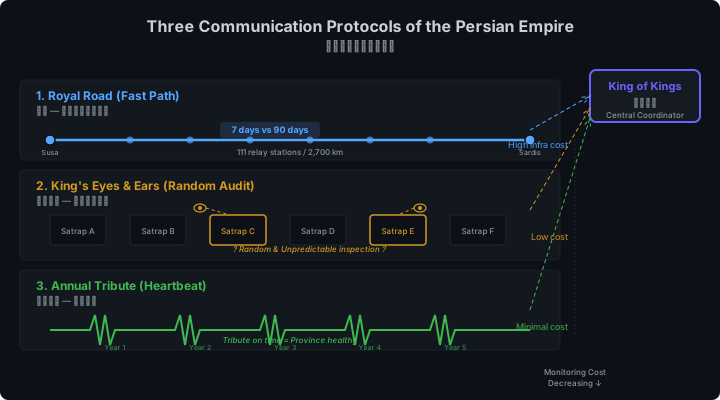
波斯帝国的治理智慧体现在三种精心设计的监控机制中:
1. 王道(Royal Road)——专用高速通信链路
长约 2700 公里,设有 111 个驿站,使用接力制(每个骑手跑一段),信使可在 7 天内跑完全程(普通旅行者需要 90 天)。
这是一个专用高速通信链路——不是用来传递所有信息,而是为关键信息保留的快速通道。在 AI 编排中,等价于为高优先级消息设置专用的 fast path,与普通任务队列分离。
2. 王之耳目(King’s Eyes and Ears)——异步健康检查
由中央直接派遣的秘密巡查官,不定期视察各行省。总督不知道他们何时会来,也不知道他们的具体身份。
这是一个异步健康检查机制——不是持续监控(太昂贵),而是随机抽查(成本可控但效果显著)。随机性使得总督无法只在检查期间表现良好,必须持续保持合规。
在 AI 编排中:随机抽检 Agent 的输出质量,而非检查每一次响应。以 O(√n) 的监控成本实现 O(n) 的质量保障。
3. 年度贡赋——Heartbeat 协议
每个行省必须按时缴纳固定额度的贡赋。只要贡赋按时到达,中央就认为该行省运行正常。
这是一个heartbeat 协议——不关心内部细节,只关心关键输出指标。一旦关键指标异常(贡赋延迟或减少),就触发「王之耳目」的深入调查。
| 波斯通信协议 | 分布式系统等价物 | 监控成本 | 响应速度 |
|---|---|---|---|
| 王道 | Fast path / QoS | 高(基础设施投资) | 7 天 vs 90 天 |
| 王之耳目 | 随机审计 / Chaos Engineering | 低(只需少数巡查官) | 不定期 |
| 年度贡赋 | Heartbeat / Health check | 极低(被动接收) | 年度 |
最终一致性的智慧
这套设计的核心智慧是:在通信成本极高的环境下,不追求强一致性(strong consistency),而是通过异步监控维持最终一致性(eventual consistency)。
- 只要关键指标(贡赋)正常 → 不干预
- 关键指标异常 → 触发深入调查
- 调查发现问题 → 中央介入修正
- 修正完成 → 恢复自治
这与现代微服务架构中的监控哲学高度一致:不试图同步控制每个服务的内部状态,而是监控关键指标(延迟、错误率、吞吐量),只在指标异常时介入。
极致的异构容忍
Wiesehöfer(2001)指出[2],波斯帝国内部同时容纳了多种完全不同的治理模式:
- 希腊式城邦自治(爱奥尼亚海岸)
- 埃及式法老神权(尼罗河流域)
- 巴比伦式神庙经济(两河流域)
- 犹太式宗教社区(巴勒斯坦)
- 印度式种姓制度(东部行省)
中央只关心两件事:贡赋和军事动员。除此之外,各行省保留了自己的法律、宗教、语言和社会结构。
这种极致的异构容忍在 AI 编排中意味着:不强制所有 Agent 使用同一种协议、同一种输出格式、同一种推理方式。只要最终输出满足接口约定(贡赋),内部实现完全自由。
接口约定(贡赋):
{
  "task_id": "xxx",
  "result": "...",
  "confidence": 0.85,
  "latency_ms": 1200
}

内部实现:随你——
  Claude 用 chain-of-thought
  GPT 用 function calling
  DeepSeek 用 reasoning tokens
  Kimi 用 thinking mode
反面教材:波兰的 Liberum Veto
与波斯的松耦合成功形成鲜明对比的是波兰立陶宛联邦的失败。
波兰的「自由否决权」(Liberum Veto)——任何一个议员都可以否决任何决议——最终导致了国家的灭亡[3]。Davies 详细记录了 18 世纪的波兰议会如何因为单个议员的否决而一次又一次地无法做出任何决策,最终被俄罗斯、普鲁士和奥地利三次瓜分。
波斯和波兰的对比揭示了联邦模式的关键参数:一致性阈值的设定。
| 制度 | 一致性阈值 | 结果 | 存续时间 |
|---|---|---|---|
| 波斯总督制 | 极低(只要贡赋正常) | 高灵活性,200 年稳定 | ~220 年 |
| 神圣罗马帝国 | 低(帝国议会简单多数) | 高灵活性,844 年 | 844 年 |
| 雅典民主 | 中(简单多数) | 效率与参与的平衡 | ~186 年 |
| 蒙古忽里勒台 | 高(全体共识) | 高合法性但慢 | ~162 年 |
| 波兰 Sejm | 100%(单票否决) | 完全瘫痪 | 灭国 |
启示:在分布式系统中,强一致性要求的阈值必须合理设计。 100% 共识看似最「公平」,实则导致系统瘫痪。拜占庭容错算法(BFT)允许最多 1/3 节点故障;比特币工作量证明只要求 51% 算力——阈值的设定不是数学问题,而是权衡问题。
启示总结
- 最终一致性 > 强一致性:通信成本高时,不追求实时同步,而是通过异步监控维持系统健康
- 三层监控:快速通道(关键消息)+ 随机审计(质量抽查)+ 心跳协议(存活检测)
- 异构容忍:只约定接口,不限制内部实现——最大化每个 Agent 的独立优化空间
- 一致性阈值:波兰的教训——阈值设定错误的后果可以是致命的
- 松耦合 + 关键指标:监控少数关键指标而非全部内部状态,以 O(√n) 成本保障 O(n) 质量
下一篇:CivAgent 系列(七):跨学科桥梁、技术实现与认识论反思
项目地址:github.com/LeoLin990405/CivAgent
参考文献
[1] Briant, P. (2002). From Cyrus to Alexander: A History of the Persian Empire. Winona Lake, IN: Eisenbrauns.
[2] Wiesehöfer, J. (2001). Ancient Persia: From 550 BC to 650 AD. London: I.B. Tauris.
[3] Davies, N. (2005). God’s Playground: A History of Poland (Revised ed., 2 vols.). New York: Columbia University Press.
[4] Wilson, P. H. (2016). Heart of Europe: A History of the Holy Roman Empire. Cambridge, MA: Harvard University Press.
</small>
Series Navigation: I: Framing the Problem · II: Six Orchestration Modes · III: Tang Dynasty Three Departments · IV: Ming Dynasty Dual-Track System · V: Athenian Democracy · VI: Persian Satrapy System · VII: Theory and Implementation
The previous article analyzed the information aggregation mechanisms of Athenian democracy. This article turns to the earliest successfully operating “microservices architecture” in human history — the satrapy system of the Achaemenid Persian Empire.
Historical Background
The Achaemenid Persian Empire was the first empire in human history to span three continents, covering approximately 5.5 million square kilometers (from Egypt to India) with a population of roughly 49 million. How could such a vast territory be governed without the telegraph, railways, or the internet?
Briant’s (2002) research demonstrates[1] that Persia’s answer was layered autonomy combined with asynchronous monitoring.
Hierarchical Structure
┌────────────────────────────────────────────────────────┐
│  Central Coordinator (King of Kings)                   │
│  - Monitors only key metrics (latency, success rate,   │
│    cost)                                               │
│  - Does not interfere with internal implementations    │
│  - Triggers deep investigation upon anomalies          │
└──────┬─────────────────┬─────────────────┬─────────────┘
       │                 │                 │
   ┌───▼────┐       ┌───▼────┐       ┌───▼────┐
   │Service A│       │Service B│       │Service C│
   │(Satrap  │       │(Satrap  │       │(Satrap  │
   │    A)   │       │    B)   │       │    C)   │
   │Claude   │       │Gemini   │       │Kimi     │
   │Autonomy │       │Autonomy │       │Autonomy │
   └─────────┘       └─────────┘       └─────────┘
- King of Kings — Supreme authority, focused only on global metrics
- Satrap — Approximately 20 provinces, each equivalent to an “independent service”
- Local Officials — Autonomous within the satrap’s framework
Three Communication Protocols
The governance wisdom of the Persian Empire is embodied in three carefully designed monitoring mechanisms:
1. The Royal Road — Dedicated High-Speed Communication Link
Approximately 2,700 kilometers long with 111 relay stations using a relay system (each rider covering one segment), couriers could traverse the entire distance in 7 days (ordinary travelers required 90 days).
This was a dedicated high-speed communication link — not for transmitting all information, but a fast lane reserved for critical messages. In AI orchestration, this is equivalent to establishing a dedicated fast path for high-priority messages, separated from the ordinary task queue.
2. The King’s Eyes and Ears — Asynchronous Health Checks
Secret inspectors dispatched directly by the central authority conducted irregular inspections of the provinces. Satraps did not know when they would arrive or their specific identities.
This was an asynchronous health check mechanism — not continuous monitoring (too expensive), but random spot checks (cost-effective yet highly impactful). The randomness ensured that satraps could not perform well only during inspection periods; they had to maintain compliance continuously.
In AI orchestration: randomly audit the output quality of Agents rather than inspecting every single response. Achieve O(n) quality assurance at O(sqrt(n)) monitoring cost.
3. Annual Tribute — The Heartbeat Protocol
Each province was required to deliver a fixed amount of tribute on time. As long as tribute arrived on schedule, the central authority considered that province to be operating normally.
This was a heartbeat protocol — indifferent to internal details, concerned only with key output metrics. Once a key metric became anomalous (tribute delayed or diminished), it triggered a deep investigation by the “King’s Eyes and Ears.”
| Persian Protocol | Distributed Systems Equivalent | Monitoring Cost | Response Speed |
|---|---|---|---|
| Royal Road | Fast path / QoS | High (infrastructure investment) | 7 days vs. 90 days |
| King’s Eyes and Ears | Random audit / Chaos Engineering | Low (requires only a few inspectors) | Irregular |
| Annual Tribute | Heartbeat / Health check | Very low (passive reception) | Annual |
The Wisdom of Eventual Consistency
The core insight of this design is: in an environment where communication costs are extremely high, do not pursue strong consistency; instead, maintain eventual consistency through asynchronous monitoring.
- Key metrics (tribute) normal → no intervention
- Key metrics anomalous → trigger deep investigation
- Investigation reveals problems → central authority intervenes to correct
- Correction complete → restore autonomy
This aligns closely with the monitoring philosophy of modern microservices architectures: rather than attempting to synchronously control the internal state of every service, monitor key metrics (latency, error rate, throughput) and intervene only when metrics become anomalous.
Radical Heterogeneity Tolerance
Wiesehofer (2001) observed[2] that the Persian Empire simultaneously accommodated multiple entirely different governance models:
- Greek-style polis autonomy (Ionian coast)
- Egyptian-style pharaonic theocracy (Nile Valley)
- Babylonian-style temple economy (Mesopotamia)
- Jewish-style religious community (Palestine)
- Indian-style caste system (eastern provinces)
The central authority cared about only two things: tribute and military mobilization. Beyond that, each province retained its own laws, religion, language, and social structure.
This radical heterogeneity tolerance means the following for AI orchestration: do not force all Agents to use the same protocol, the same output format, or the same reasoning approach. As long as the final output satisfies the interface contract (tribute), internal implementation is entirely free.
Interface contract (tribute):
{
  "task_id": "xxx",
  "result": "...",
  "confidence": 0.85,
  "latency_ms": 1200
}

Internal implementation: your choice —
  Claude uses chain-of-thought
  GPT uses function calling
  DeepSeek uses reasoning tokens
  Kimi uses thinking mode
Cautionary Tale: Poland’s Liberum Veto
In stark contrast to Persia’s successful loose coupling stands the failure of the Polish-Lithuanian Commonwealth.
Poland’s “free veto” (Liberum Veto) — whereby any single legislator could veto any resolution — ultimately led to the nation’s destruction[3]. Davies documented in detail how the 18th-century Polish Sejm, paralyzed again and again by individual vetoes, was rendered incapable of making any decisions whatsoever, and how Poland was ultimately partitioned three times among Russia, Prussia, and Austria.
The contrast between Persia and Poland reveals the critical parameter of federative models: the setting of the consistency threshold.
| System | Consistency Threshold | Outcome | Duration |
|---|---|---|---|
| Persian Satrapy | Very low (tribute on schedule suffices) | High flexibility, 200 years of stability | ~220 years |
| Holy Roman Empire | Low (Imperial Diet simple majority) | High flexibility, 844 years | 844 years |
| Athenian Democracy | Medium (simple majority) | Balance of efficiency and participation | ~186 years |
| Mongol Kurultai | High (full consensus) | High legitimacy but slow | ~162 years |
| Polish Sejm | 100% (single-vote veto) | Complete paralysis | State extinction |
Lesson: in distributed systems, the threshold for strong consistency requirements must be designed judiciously. A 100% consensus requirement appears maximally “fair” but in practice leads to system paralysis. Byzantine Fault Tolerance (BFT) algorithms tolerate up to 1/3 node failures; Bitcoin’s proof-of-work requires only 51% of computing power — setting the threshold is not a mathematical problem but one of trade-offs.
Key Takeaways
- Eventual consistency > strong consistency: When communication costs are high, do not pursue real-time synchronization; instead, maintain system health through asynchronous monitoring
- Three-layer monitoring: Fast lane (critical messages) + random audits (quality spot checks) + heartbeat protocol (liveness detection)
- Heterogeneity tolerance: Specify only the interface, not the internal implementation — maximize each Agent’s independent optimization space
- Consistency threshold: The lesson of Poland — the consequences of an incorrectly set threshold can be fatal
- Loose coupling + key metrics: Monitor a small number of key metrics rather than all internal state, achieving O(n) quality at O(sqrt(n)) cost
Next article: CivAgent Series (VII): Interdisciplinary Bridges, Technical Implementation, and Epistemological Reflections
Project repository: github.com/LeoLin990405/CivAgent
References
[1] Briant, P. (2002). From Cyrus to Alexander: A History of the Persian Empire. Winona Lake, IN: Eisenbrauns.
[2] Wiesehöfer, J. (2001). Ancient Persia: From 550 BC to 650 AD. London: I.B. Tauris.
[3] Davies, N. (2005). God’s Playground: A History of Poland (Revised ed., 2 vols.). New York: Columbia University Press.
[4] Wilson, P. H. (2016). Heart of Europe: A History of the Holy Roman Empire. Cambridge, MA: Harvard University Press.
</small>