CivAgent 系列(二):六种编排模式的类型学 CivAgent Series (II): A Typology of Six Orchestration Modes
系列导航:一:问题的提出 · 二:六种编排模式 · 三:唐代三省六部 · 四:明代双轨制 · 五:雅典民主 · 六:波斯总督制 · 七:理论与实现
上一篇我们建立了核心论点:人类 5000 年的政治制度史是一部经过极端条件压力测试的「组织架构设计模式库」。本篇从 57 种政体中提炼出 6 种核心编排模式。
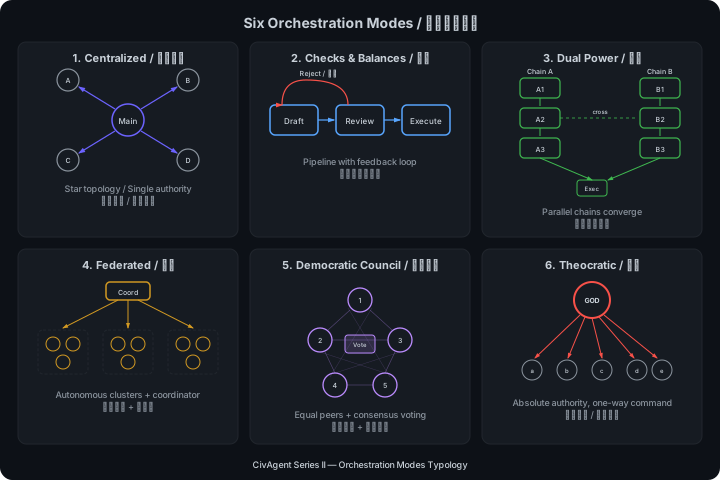
这 6 种模式并非随意归纳,而是经过了三重理论验证:
- 政治学传统:与亚里士多德《政治学》以来 2400 年政体分类学传统的对话[1]
- 组织理论:与明茨伯格(Mintzberg)五种组织形态的结构同构[2]
- MAS 研究:与 Wooldridge-Jennings 的 Agent 架构分类的映射关系[3]
1. 中央集权模式(Centralized)
代表政体:秦(三公九卿,221-206 BC)、元(行省制,1271-1368)、法国绝对君主制(1643-1789)、苏联(政治局制,1922-1991)、拿破仑帝国(1804-1815)、普鲁士(军事官僚制,1701-1918)、孔雀王朝(政事论制,322-185 BC)
AI 实现:
                ┌───────────┐
                │ Main Agent│
                │ (皇帝/CEO)│
                └─────┬─────┘
         ┌────────┬───┴───┬────────┐
         ▼        ▼       ▼        ▼
    ┌────────┐┌───────┐┌───────┐┌───────┐
    │Agent A ││Agent B││Agent C││Agent D│
    │(丞相)  ││(御史) ││(太尉) ││(少府) │
    └────────┘└───────┘└───────┘└───────┘
单一 main agent 统管所有 sub-agent。所有决策流经同一个节点。命令链清晰,无歧义。
理论基础:蒂利(Tilly)在《强制、资本与欧洲国家》中指出,高度集权的国家能够快速动员资源、统一执行,但面对复杂环境时缺乏灵活性[4]。Lewis 分析了秦制的设计逻辑[5]:秦始皇面对的核心问题是统一六国后如何维持一致性——集权是解决异构性(heterogeneity)的最直接手段。
但纯集权的脆弱性在秦朝崩溃中暴露无遗。睡虎地秦简揭示[6]:秦朝的法律条文极其详尽,但没有任何制度化的纠错机制。当赵高伪造诏书时,整个系统没有任何环节能够质疑——因为在纯集权模型中,质疑最高权威本身就是不被允许的。
对应明茨伯格的「简单结构」(Simple Structure)——权力集中于战略顶点,中间管理层极薄[2]。
何时使用:紧急任务、需要快速一致决策、短期项目冲刺、环境简单且可预测。
何时避免:长期运行、高复杂度环境、需要多角度审核、容错要求高。
2. 制衡模式(Checks & Balances)
代表政体:唐(三省六部,618-907)、宋(二府三司,960-1279)、罗马共和国(509-27 BC)、美国联邦(1789-至今)、威尼斯共和国(697-1797)、朝鲜王朝(三司言谏,1392-1897)
AI 实现:
┌──────────┐      ┌──────────┐      ┌──────────┐
│ Draft    │ ───→ │ Review   │ ───→ │ Execute  │
│ Agent    │      │ Agent    │      │ Agent    │
│ (中书省)  │ ←─── │ (门下省)  │      │ (尚书省)  │
│          │ 驳回  │          │      │          │
└──────────┘      └──────────┘      └──────────┘
多个顶层 Agent 互相审核——起草者不能自己批准,审核者不能自己执行。核心机制是强制性的异步审核。
理论基础:孟德斯鸠在《论法的精神》中奠定了分权制衡的理论基础[7]。在 AI 编排中,制衡的优势在于质量保障。但每增加一个审核节点,就增加一笔「交易成本」——科斯(Coase)的交易成本理论给出了精确的答案[8]。
威尼斯共和国提供了一个极端案例。Lane(1973)详细描述了威尼斯的反腐制衡机制[9]:总督选举需要 11 轮交替抽签和投票;十人委员会专门监察总督和贵族;任何贵族都可以匿名举报(「狮子口」信箱)。这套极其复杂的制衡系统使威尼斯存续了 1100 年。
对应明茨伯格的「机械官僚制」(Machine Bureaucracy)[2]。
何时使用:高质量要求、防错场景、代码审查、合规检查、长期运行的生产系统。
何时避免:需要快速迭代、探索性任务、资源有限。
深度案例见第三篇:唐代三省六部。
3. 双轨模式(Dual Power)
代表政体:明(内阁票拟+司礼监批红,1368-1644)、斯巴达(双王制,900-192 BC)、辽(南北面官制,907-1125)、哈布斯堡(二元君主制,1867-1918)
AI 实现:
     ┌──────────────┐        ┌──────────────┐
     │   Chain A     │        │   Chain B     │
     │ (内阁/文官)    │        │ (司礼监/宦官)  │
     │               │        │               │
     │  Agent A1     │        │  Agent B1     │
     │  Agent A2     │──交叉──│  Agent B2     │
     │  Agent A3     │  审批  │  Agent B3     │
     └──────┬───────┘        └──────┬───────┘
            │                        │
            └──────────┬─────────────┘
                       ▼
                  ┌─────────┐
                  │ 执行层   │
                  └─────────┘
两个独立的决策链各自评估同一份方案。任何一方的系统性偏差都会被另一方捕获。
理论基础:斯巴达的两个国王分别来自两个不同的王族,在战时一人留守一人出征。Cartledge(2003)指出这是高可用性(High Availability)的古典实现——主备切换(failover)[10]。
辽朝的南北面官制是双轨制的另一种形态。Wittfogel 和冯家昇(1949)的研究表明[11]:北面官沿用契丹部落制管理游牧事务,南面官采用唐制管理农耕区。核心洞见是:当系统需要同时处理两种性质完全不同的任务时,与其强行统一到一套流程,不如让两套专用流程各自运行。
对应明茨伯格的「专业官僚制」(Professional Bureaucracy)[2]。
何时使用:需要双重审批、两条产品线并行、跨领域任务、需要高可用性。
深度案例见第四篇:明代双轨制。
4. 联邦模式(Federated)
代表政体:周(宗法分封,c.1046-256 BC)、三国(220-280)、神圣罗马帝国(选帝侯制,962-1806)、波斯帝国(总督制,550-330 BC)、波兰立陶宛联邦(1569-1795)
AI 实现:
              ┌─────────┐
              │ 中央协调  │ (最小化干预)
              └────┬────┘
         ┌────────┼────────┐
         ▼        ▼        ▼
    ┌─────────┐┌─────────┐┌─────────┐
    │ Group A ││ Group B ││ Group C │
    │ (魏)    ││ (蜀)    ││ (吴)    │
    │ ┌─┐┌─┐ ││ ┌─┐┌─┐ ││ ┌─┐┌─┐ │
    │ │A││B│ ││ │C││D│ ││ │E││F│ │
    │ └─┘└─┘ ││ └─┘└─┘ ││ └─┘└─┘ │
    └─────────┘└─────────┘└─────────┘
     (独立决策)  (独立决策)  (独立决策)
理论基础:CAP 定理在古代政治中有完美对应——中央控制力(Consistency)、地方灵活性(Availability)、通信效率(Partition Tolerance)不可能同时最大化。
Peter Wilson(2016)对神圣罗马帝国的研究揭示了联邦模式长期存续的秘密[12]:这个看似「松散」的联邦结构之所以能存续 844 年,不是因为它特别「强大」,而是因为它足够灵活——每个成员邦都能根据本地条件调整治理方式,同时通过帝国议会这个「共享消息总线」来协调跨邦事务。
对应明茨伯格的「事业部制」(Divisionalized Form)[2]。
何时使用:多团队并行、微服务架构、各子任务独立性高、需要区域差异化。
深度案例见第六篇:波斯总督制。
5. 民主议会模式(Democratic Council)
代表政体:雅典(直接民主,508-322 BC)、蒙古(忽里勒台,1206-1368)、维京(庭议制,800-1100)、瑞士(直接民主+合议制,1291-至今)、欧盟(三方共决,1993-至今)
AI 实现:
    ┌────────┐  ┌────────┐  ┌────────┐  ┌────────┐
    │Agent 1 │  │Agent 2 │  │Agent 3 │  │Agent 4 │
    │(公民A)  │  │(公民B)  │  │(公民C)  │  │(公民D)  │
    └───┬────┘  └───┬────┘  └───┬────┘  └───┬────┘
        │           │           │           │
        └─────┬─────┴─────┬─────┘           │
              ▼           ▼                 │
         ┌─────────────────────────────────┐
         │       议事/投票/共识             │
         │  (公民大会 / 忽里勒台 / 庭议)    │
         └─────────────┬───────────────────┘
                       ▼
                  ┌─────────┐
                  │ 执行决议  │
                  └─────────┘
所有 Agent 平等参与决策。通过投票、辩论或共识机制选择最优方案。
理论基础:阿罗不可能定理(1951)从理论上证明了民主决策的根本困难[13]。但历史表明,实际运行的民主制度通过各种「不完美但可用」的机制绕过了这个理论限制:雅典用抽签取代选举[14];蒙古忽里勒台用共识决[15];维京庭议用公开辩论+声量投票[16]。
Condorcet 陪审团定理提供了数学支持[17]:如果每个投票者独立做出正确判断的概率大于 0.5,那么多数决的准确率随投票人数的增加而趋近于 1。这与集成学习(ensemble learning)的思路完全一致[18]。
对应明茨伯格的「临时体制」(Adhocracy)[2]。
何时使用:头脑风暴、创意方案探索、需要多角度分析、高不确定性场景。
深度案例见第五篇:雅典民主。
6. 神权模式(Theocratic)
代表政体:商(神权贵族制,c.1600-1046 BC)、太平天国(天王制,1851-1864)、古埃及(法老神权制,3100-30 BC)、拜占庭(神权独裁制,330-1453)、萨法维帝国(什叶派神权君主制,1501-1736)、高棉帝国(神王制,802-1431)
最高 Agent 拥有绝对权威。没有审核环节,没有投票机制。决策即执行。
理论基础:这种模式看似「原始」,但它解决的问题是特定的:当速度和一致性的优先级远高于质量和参与度时,绝对权威是最高效的协调机制。
魏特夫在《东方专制主义》中分析了「水利帝国」与集权的关系[19]:大规模灌溉工程需要数万人在统一指挥下协作,绝对服从不是压迫而是工程必需。
Keightley(1978)对商代甲骨文的研究揭示了一个隐藏机制[20]:商王通过占卜来做决策,表面上是「听从神意」,实际上是用外部随机性来打破决策僵局——与「随机化算法」有异曲同工之处。
Kemp(2018)对古埃及的研究表明[21]:法老的「神性」还解决了一个实际的组织问题——信任。在通信成本极高的帝国中,「神在看着你」减少了监控成本。在 AI 系统中等价于声誉机制。
何时使用:紧急危机处理、需要绝对一致性的部署操作、时间约束极紧的任务。
何时避免:几乎所有其他场景。这是 6 种模式中适用范围最窄的一种。
总览:6 种模式 × 明茨伯格映射
| 明茨伯格组织形态 | CivAgent 编排模式 | 核心协调机制 | 关键设计变量 |
|---|---|---|---|
| 简单结构 | 中央集权 / 神权 | 直接监督 | 战略顶点的信息处理能力 |
| 机械官僚制 | 制衡 | 工作流程标准化 | 流程的完备性和一致性 |
| 专业官僚制 | 双轨 | 技能标准化 | 专业领域的独立性 |
| 事业部制 | 联邦 | 输出标准化 | 事业部之间的耦合度 |
| 临时体制 | 民主议会 | 相互调适 | 创新性 vs 可预测性 |
下一篇:CivAgent 系列(三):唐代三省六部——质量门控的经典实现
项目地址:github.com/LeoLin990405/CivAgent
参考文献
[1] Aristotle. Politics. Translated by C. D. C. Reeve (1998). Indianapolis: Hackett Publishing.
[2] Mintzberg, H. (1979). The Structuring of Organizations: A Synthesis of the Research. Englewood Cliffs, NJ: Prentice-Hall.
[3] Wooldridge, M. & Jennings, N. R. (1995). “Intelligent Agents: Theory and Practice.” The Knowledge Engineering Review, 10(2), 115-152.
[4] Tilly, C. (1990). Coercion, Capital, and European States, AD 990–1992. Cambridge, MA: Blackwell.
[5] Lewis, M. E. (2007). The Early Chinese Empires: Qin and Han. Cambridge, MA: Harvard University Press.
[6] 睡虎地秦简整理小组 (1978).《睡虎地秦墓竹简》[Bamboo Slips from the Qin Tombs at Shuihudi]. 北京:文物出版社.
[7] Montesquieu, C. (1748). De l’esprit des lois. Translated by A. Cohler et al. (1989). Cambridge: Cambridge University Press.
[8] Coase, R. H. (1937). “The Nature of the Firm.” Economica, 4(16), 386-405.
[9] Lane, F. C. (1973). Venice: A Maritime Republic. Baltimore: Johns Hopkins University Press.
[10] Cartledge, P. (2003). The Spartans: The World of the Warrior-Heroes of Ancient Greece. New York: Vintage.
[11] Wittfogel, K. A. & 冯家昇 [Feng Chia-sheng] (1949). History of Chinese Society: Liao (907–1125). New York: Macmillan.
[12] Wilson, P. H. (2016). Heart of Europe: A History of the Holy Roman Empire. Cambridge, MA: Harvard University Press.
[13] Arrow, K. J. (1951). Social Choice and Individual Values. New York: Wiley.
[14] Hansen, M. H. (1991). The Athenian Democracy in the Age of Demosthenes. Oxford: Blackwell.
[15] Weatherford, J. (2004). Genghis Khan and the Making of the Modern World. New York: Crown.
[16] Price, N. (2020). Children of Ash and Elm: A History of the Vikings. New York: Basic Books.
[17] Condorcet, M. (1785). Essai sur l’application de l’analyse à la probabilité des décisions rendues à la pluralité des voix. Paris.
[18] Dietterich, T. G. (2000). “Ensemble Methods in Machine Learning.” Multiple Classifier Systems, LNCS 1857, 1-15.
[19] Wittfogel, K. A. (1957). Oriental Despotism: A Comparative Study of Total Power. New Haven: Yale University Press.
[20] Keightley, D. N. (1978). Sources of Shang History: The Oracle-Bone Inscriptions of Bronze Age China. Berkeley: University of California Press.
[21] Kemp, B. (2018). Ancient Egypt: Anatomy of a Civilization (3rd ed.). London: Routledge.
</small>
Series Navigation: I: Framing the Problem · II: Six Orchestration Modes · III: Tang Dynasty Three Departments · IV: Ming Dynasty Dual Power · V: Athenian Democracy · VI: Persian Satrapy System · VII: Theory and Implementation
In the previous post, we established our core thesis: humanity’s 5,000-year history of political institutions constitutes a stress-tested “design pattern library” for organizational architecture. In this post, we distill six core orchestration modes from 57 historical polities.
These six modes are not arbitrary generalizations; they have been validated through a threefold theoretical triangulation:
- Political science tradition: A dialogue with the 2,400-year tradition of regime classification dating from Aristotle’s Politics (《政治学》)[1]
- Organization theory: Structural isomorphism with Mintzberg’s five organizational configurations[2]
- MAS research: Mapping to the Wooldridge-Jennings taxonomy of agent architectures[3]
1. Centralized Mode
Representative polities: Qin (Three Lords and Nine Ministers, 221-206 BC), Yuan (Provincial System, 1271-1368), French Absolute Monarchy (1643-1789), Soviet Union (Politburo System, 1922-1991), Napoleonic Empire (1804-1815), Prussia (Military Bureaucracy, 1701-1918), Maurya Empire (Arthashastra System, 322-185 BC)
AI implementation:
                 ┌────────────┐
                 │ Main Agent │
                 │(Emperor/CEO)│
                 └─────┬──────┘
         ┌────────┬────┴───┬────────┐
         ▼        ▼        ▼        ▼
    ┌────────┐┌────────┐┌────────┐┌────────┐
    │Agent A ││Agent B ││Agent C ││Agent D │
    │(PM)    ││(Censor)││(Marshal)││(Steward)│
    └────────┘└────────┘└────────┘└────────┘
A single main agent governs all sub-agents. Every decision flows through a single node. The chain of command is unambiguous.
Theoretical basis: Tilly, in Coercion, Capital, and European States (《强制、资本与欧洲国家》), argued that highly centralized states can rapidly mobilize resources and enforce uniform execution, yet lack flexibility when confronting complex environments[4]. Lewis analyzed the design logic of the Qin system[5]: the First Emperor’s central challenge after unifying six kingdoms was maintaining consistency – centralization was the most direct means of resolving heterogeneity.
Yet the fragility of pure centralization was laid bare in the Qin collapse. The Shuihudi bamboo slips reveal[6]: Qin’s legal code was extraordinarily detailed, but contained no institutionalized error-correction mechanism. When Zhao Gao forged an imperial edict, no part of the system could challenge it – because in a pure centralized model, questioning supreme authority is, by definition, impermissible.
This corresponds to Mintzberg’s “Simple Structure” – power concentrated at the strategic apex, with an extremely thin middle management layer[2].
When to use: Urgent tasks, scenarios requiring rapid uniform decisions, short-term project sprints, simple and predictable environments.
When to avoid: Long-running operations, high-complexity environments, scenarios requiring multi-perspective review, high fault-tolerance requirements.
2. Checks & Balances Mode
Representative polities: Tang (Three Departments and Six Ministries, 618-907), Song (Two Chancelleries and Three Fiscal Commissions, 960-1279), Roman Republic (509-27 BC), United States Federal Government (1789-present), Republic of Venice (697-1797), Joseon Dynasty (Three Censorate Offices, 1392-1897)
AI implementation:
┌──────────┐      ┌──────────┐      ┌──────────┐
│ Draft    │ ───→ │ Review   │ ───→ │ Execute  │
│ Agent    │      │ Agent    │      │ Agent    │
│(Drafting │ ←─── │(Reviewing│      │(Executive│
│ Dept)    │Reject│ Dept)    │      │ Dept)    │
└──────────┘      └──────────┘      └──────────┘
Multiple top-level agents cross-audit each other – the drafter cannot approve its own work, and the reviewer cannot execute. The core mechanism is mandatory asynchronous review.
Theoretical basis: Montesquieu laid the theoretical foundation for the separation of powers in The Spirit of the Laws (《论法的精神》)[7]. In AI orchestration, the advantage of checks and balances lies in quality assurance. However, each additional review node adds a “transaction cost” – Coase’s transaction cost theory provides a precise answer[8].
The Republic of Venice offers an extreme case. Lane (1973) described Venice’s anti-corruption checks in detail[9]: the election of the Doge required 11 rounds of alternating sortition and voting; the Council of Ten was dedicated to overseeing the Doge and the nobility; any noble could file anonymous denunciations (via the “Lion’s Mouth” letter boxes). This extraordinarily complex system of checks sustained Venice for 1,100 years.
This corresponds to Mintzberg’s “Machine Bureaucracy”[2].
When to use: High-quality requirements, error-prevention scenarios, code review, compliance checks, long-running production systems.
When to avoid: Rapid iteration needs, exploratory tasks, resource-constrained settings.
For an in-depth case study, see Part III: Tang Dynasty Three Departments.
3. Dual Power Mode
Representative polities: Ming (Grand Secretariat drafting + Directorate of Ceremonial approval, 1368-1644), Sparta (Dual Kingship, 900-192 BC), Liao (Northern and Southern Administration, 907-1125), Habsburg (Dual Monarchy, 1867-1918)
AI implementation:
     ┌──────────────┐        ┌──────────────┐
     │   Chain A     │        │   Chain B     │
     │ (Cabinet /    │        │ (Directorate /│
     │  Civil Svc)   │        │  Eunuch Svc)  │
     │               │        │               │
     │  Agent A1     │        │  Agent B1     │
     │  Agent A2     │─Cross──│  Agent B2     │
     │  Agent A3     │Approval│  Agent B3     │
     └──────┬───────┘        └──────┬───────┘
            │                        │
            └──────────┬─────────────┘
                       ▼
                ┌───────────┐
                │ Execution │
                │   Layer   │
                └───────────┘
Two independent decision chains evaluate the same proposal. Any systematic bias in one chain is caught by the other.
Theoretical basis: Sparta’s two kings came from two different royal houses; during wartime one stayed behind while the other led the campaign. Cartledge (2003) observed that this was a classical implementation of High Availability – a primary-standby failover[10].
The Liao dynasty’s Northern and Southern Administration represents another form of dual-track governance. Wittfogel and Feng Chia-sheng (冯家昇) (1949) showed[11]: the Northern Administration retained Khitan tribal structures for managing pastoral affairs, while the Southern Administration adopted Tang-style bureaucracy for agrarian regions. The key insight: when a system must handle two fundamentally different types of tasks, it is better to let two specialized pipelines run independently than to force a single unified process.
This corresponds to Mintzberg’s “Professional Bureaucracy”[2].
When to use: Dual-approval requirements, two parallel product lines, cross-domain tasks, high-availability needs.
For an in-depth case study, see Part IV: Ming Dynasty Dual Power.
4. Federated Mode
Representative polities: Zhou (Feudal Enfeoffment, c.1046-256 BC), Three Kingdoms (220-280), Holy Roman Empire (Electoral System, 962-1806), Persian Empire (Satrapy System, 550-330 BC), Polish-Lithuanian Commonwealth (1569-1795)
AI implementation:
              ┌────────────┐
              │  Central   │ (minimal intervention)
              │Coordinator │
              └─────┬──────┘
         ┌──────────┼──────────┐
         ▼          ▼          ▼
    ┌─────────┐┌─────────┐┌─────────┐
    │ Group A ││ Group B ││ Group C │
    │ (Wei)   ││ (Shu)   ││ (Wu)    │
    │ ┌─┐┌─┐ ││ ┌─┐┌─┐ ││ ┌─┐┌─┐ │
    │ │A││B│ ││ │C││D│ ││ │E││F│ │
    │ └─┘└─┘ ││ └─┘└─┘ ││ └─┘└─┘ │
    └─────────┘└─────────┘└─────────┘
    (autonomous) (autonomous) (autonomous)
Theoretical basis: The CAP theorem finds a perfect correspondence in ancient politics – Central control (Consistency), Local flexibility (Availability), and Communication efficiency (Partition Tolerance) cannot all be maximized simultaneously.
Peter Wilson’s (2016) study of the Holy Roman Empire reveals the secret of the federated mode’s longevity[12]: this ostensibly “loose” federal structure survived for 844 years not because it was particularly “strong,” but because it was sufficiently flexible – each member state could adapt its governance to local conditions, while the Imperial Diet served as a “shared message bus” for coordinating cross-state affairs.
This corresponds to Mintzberg’s “Divisionalized Form”[2].
When to use: Multi-team parallelism, microservice architectures, highly independent sub-tasks, need for regional differentiation.
For an in-depth case study, see Part VI: Persian Satrapy System.
5. Democratic Council Mode
Representative polities: Athens (Direct Democracy, 508-322 BC), Mongol Empire (Kurultai, 1206-1368), Vikings (Thing Assembly, 800-1100), Switzerland (Direct Democracy + Collegial System, 1291-present), European Union (Trilogue Co-decision, 1993-present)
AI implementation:
    ┌────────┐  ┌────────┐  ┌────────┐  ┌────────┐
    │Agent 1 │  │Agent 2 │  │Agent 3 │  │Agent 4 │
    │(Citizen│  │(Citizen│  │(Citizen│  │(Citizen│
    │   A)   │  │   B)   │  │   C)   │  │   D)   │
    └───┬────┘  └───┬────┘  └───┬────┘  └───┬────┘
        │           │           │           │
        └─────┬─────┴─────┬─────┘           │
              ▼           ▼                 │
         ┌─────────────────────────────────┐
         │   Deliberation / Vote / Consensus│
         │  (Ecclesia / Kurultai / Thing)   │
         └─────────────┬───────────────────┘
                       ▼
                ┌───────────┐
                │  Execute  │
                │ Resolution│
                └───────────┘
All agents participate in decision-making as equals. The optimal proposal is selected through voting, debate, or consensus mechanisms.
Theoretical basis: Arrow’s Impossibility Theorem (1951) proved the fundamental difficulty of democratic decision-making from a theoretical standpoint[13]. Yet history shows that functioning democracies circumvented this theoretical constraint through various “imperfect but workable” mechanisms: Athens substituted sortition for election[14]; the Mongol Kurultai used consensus decision-making[15]; the Viking Thing used open debate with acclamation voting[16].
Condorcet’s Jury Theorem provides mathematical support[17]: if each voter independently makes a correct judgment with probability greater than 0.5, then the accuracy of majority rule approaches 1 as the number of voters increases. This reasoning is entirely consistent with ensemble learning[18].
This corresponds to Mintzberg’s “Adhocracy”[2].
When to use: Brainstorming, creative solution exploration, multi-perspective analysis, high-uncertainty scenarios.
For an in-depth case study, see Part V: Athenian Democracy.
6. Theocratic Mode
Representative polities: Shang (Theocratic Aristocracy, c.1600-1046 BC), Taiping Heavenly Kingdom (Heavenly King System, 1851-1864), Ancient Egypt (Pharaonic Theocracy, 3100-30 BC), Byzantine Empire (Caesaropapism, 330-1453), Safavid Empire (Shia Theocratic Monarchy, 1501-1736), Khmer Empire (Devaraja System, 802-1431)
The supreme agent holds absolute authority. There is no review stage and no voting mechanism. Decision equals execution.
Theoretical basis: This mode may appear “primitive,” but the problem it solves is specific: when the priority of speed and consistency far exceeds that of quality and participation, absolute authority is the most efficient coordination mechanism.
Wittfogel analyzed the relationship between “hydraulic empires” and centralization in Oriental Despotism (《东方专制主义》)[19]: large-scale irrigation projects required tens of thousands of workers to collaborate under unified command; absolute obedience was not oppression but an engineering necessity.
Keightley’s (1978) study of Shang dynasty oracle bone inscriptions revealed a hidden mechanism[20]: the Shang king made decisions through divination, ostensibly “heeding the will of the gods,” but in practice using external randomness to break decision deadlocks – a principle strikingly parallel to randomized algorithms.
Kemp’s (2018) study of ancient Egypt demonstrated[21]: the pharaoh’s “divinity” also solved a practical organizational problem – trust. In an empire with extremely high communication costs, “the gods are watching you” reduced monitoring costs. In AI systems, this is equivalent to a reputation mechanism.
When to use: Emergency crisis response, deployment operations requiring absolute consistency, tasks under extremely tight time constraints.
When to avoid: Nearly all other scenarios. This is the narrowest in applicable scope of all six modes.
Overview: Six Modes x Mintzberg Mapping
| Mintzberg Configuration | CivAgent Orchestration Mode | Core Coordination Mechanism | Key Design Variable |
|---|---|---|---|
| Simple Structure | Centralized / Theocratic | Direct supervision | Information-processing capacity of the strategic apex |
| Machine Bureaucracy | Checks & Balances | Standardization of work processes | Completeness and consistency of processes |
| Professional Bureaucracy | Dual Power | Standardization of skills | Independence of professional domains |
| Divisionalized Form | Federated | Standardization of outputs | Coupling between divisions |
| Adhocracy | Democratic Council | Mutual adjustment | Innovation vs. predictability |
Next post: CivAgent Series (III): Tang Dynasty Three Departments – A Classical Implementation of Quality Gates
Project repository: github.com/LeoLin990405/CivAgent
References
[1] Aristotle. Politics. Translated by C. D. C. Reeve (1998). Indianapolis: Hackett Publishing.
[2] Mintzberg, H. (1979). The Structuring of Organizations: A Synthesis of the Research. Englewood Cliffs, NJ: Prentice-Hall.
[3] Wooldridge, M. & Jennings, N. R. (1995). “Intelligent Agents: Theory and Practice.” The Knowledge Engineering Review, 10(2), 115-152.
[4] Tilly, C. (1990). Coercion, Capital, and European States, AD 990–1992. Cambridge, MA: Blackwell.
[5] Lewis, M. E. (2007). The Early Chinese Empires: Qin and Han. Cambridge, MA: Harvard University Press.
[6] 睡虎地秦简整理小组 [Shuihudi Qin Bamboo Slips Compilation Group] (1978).《睡虎地秦墓竹简》[Bamboo Slips from the Qin Tombs at Shuihudi]. 北京:文物出版社 [Beijing: Cultural Relics Press].
[7] Montesquieu, C. (1748). De l’esprit des lois. Translated by A. Cohler et al. (1989). Cambridge: Cambridge University Press.
[8] Coase, R. H. (1937). “The Nature of the Firm.” Economica, 4(16), 386-405.
[9] Lane, F. C. (1973). Venice: A Maritime Republic. Baltimore: Johns Hopkins University Press.
[10] Cartledge, P. (2003). The Spartans: The World of the Warrior-Heroes of Ancient Greece. New York: Vintage.
[11] Wittfogel, K. A. & 冯家昇 [Feng Chia-sheng] (1949). History of Chinese Society: Liao (907–1125). New York: Macmillan.
[12] Wilson, P. H. (2016). Heart of Europe: A History of the Holy Roman Empire. Cambridge, MA: Harvard University Press.
[13] Arrow, K. J. (1951). Social Choice and Individual Values. New York: Wiley.
[14] Hansen, M. H. (1991). The Athenian Democracy in the Age of Demosthenes. Oxford: Blackwell.
[15] Weatherford, J. (2004). Genghis Khan and the Making of the Modern World. New York: Crown.
[16] Price, N. (2020). Children of Ash and Elm: A History of the Vikings. New York: Basic Books.
[17] Condorcet, M. (1785). Essai sur l’application de l’analyse à la probabilité des décisions rendues à la pluralité des voix. Paris.
[18] Dietterich, T. G. (2000). “Ensemble Methods in Machine Learning.” Multiple Classifier Systems, LNCS 1857, 1-15.
[19] Wittfogel, K. A. (1957). Oriental Despotism: A Comparative Study of Total Power. New Haven: Yale University Press.
[20] Keightley, D. N. (1978). Sources of Shang History: The Oracle-Bone Inscriptions of Bronze Age China. Berkeley: University of California Press.
[21] Kemp, B. (2018). Ancient Egypt: Anatomy of a Civilization (3rd ed.). London: Routledge.
</small>