CivAgent 系列(五):雅典民主——分布式知识管理系统 CivAgent Series (V): Athenian Democracy — A Distributed Knowledge Management System
系列导航:一:问题的提出 · 二:六种编排模式 · 三:唐代三省六部 · 四:明代双轨制 · 五:雅典民主 · 六:波斯总督制 · 七:理论与实现
上一篇分析了明代双轨制的交叉验证机制。本篇转向一种根本不同的编排哲学——雅典的直接民主制,以及它作为「分布式知识管理系统」的深层含义。
历史背景
雅典在公元前 508 年克里斯提尼改革后建立了直接民主制度。核心机构是公民大会(ecclesia),所有成年男性公民(约 3-6 万人,实际参会通常 6000 人左右)有权参与所有重大决策——宣战、和平、财政、法律、外交。
但 Hansen(1991)的研究表明[1],雅典的制度设计远比「多数人投票」复杂:
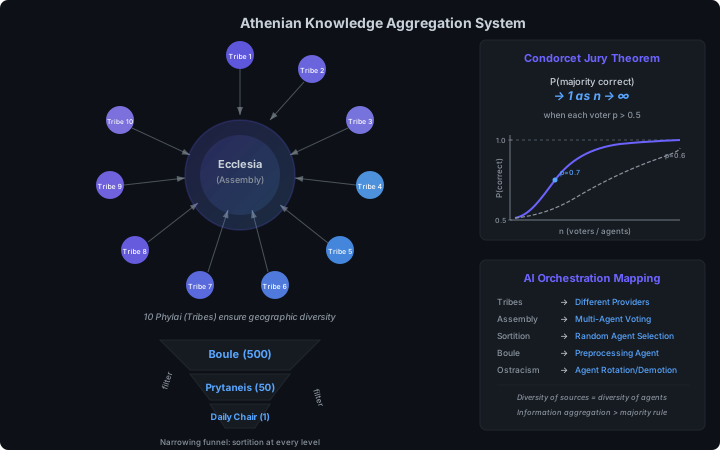
- 五百人议事会(Boule):从 10 个部落各抽签选 50 人,任期一年,不可连任。负责设定公民大会的议程和预审提案。
- 轮值主席(Prytaneis):50 人一组轮流执政 36 天。每天的主席由抽签决定——一个雅典公民一生中有约 1/3 的概率当一天「国家元首」。
- 陶片放逐法(Ostracism):每年一次投票,得票最多的公民被放逐 10 年——一种防独裁安全阀。
- 审判制度:陪审团规模为 201-6001 人(必须为奇数),全部由抽签产生——大规模陪审团使贿赂变得不经济。
Ober 的革命性论点:民主 = 知识管理
Josiah Ober 在 Mass and Elite in Democratic Athens(1989)中提出了一个初步洞见[2]:雅典民主在军事和经济上优于同时期的寡头政体(如斯巴达、科林斯),核心原因不是「多数人比少数人聪明」,而是信息聚合效应——6000 人的公民大会迫使分散在城邦各处的地方知识被汇聚到一个决策点。
他后来在 Democracy and Knowledge(2008)中进一步发展了这个论点[3]:雅典的制度优势本质上是一种分布式知识管理系统。
论证逻辑:
- 雅典是一个贸易型城邦,核心资源是信息(哪条航线安全、哪个市场价格高、敌人的军队在哪里)
- 这些信息分散在不同的公民手中(渔民、商人、农民、工匠各有各的信息)
- 公民大会和议事会提供了一个制度化的信息聚合平台——迫使分散的地方知识流向决策中心
- 抽签制确保了信息源的多样性——不像选举制那样倾向于选出相似背景的精英
AI 编排的精确映射
当我们让多个 Agent 独立分析同一个问题然后聚合结果时,本质上就是在复制雅典公民大会的信息聚合机制。
每个 Agent(Claude、GPT、Gemini、DeepSeek)就像来自不同「部落」的公民——它们的训练数据、推理偏好、知识盲点各不相同,因此它们的独立判断提供了不同维度的信息。
| 雅典制度 | AI 编排 |
|---|---|
| 公民大会(6000 人投票) | 多 Agent 投票/聚合 |
| 10 个部落(确保地域多样性) | 不同 Provider(确保模型多样性) |
| 抽签选官(防止精英垄断) | 随机选择 Agent 组合(防止偏见固化) |
| 五百人议事会(预审议程) | 预处理 Agent(过滤/排序提案) |
| 陶片放逐法(防独裁) | Agent 轮换/降权机制 |
数学保证:Condorcet 陪审团定理
Condorcet 陪审团定理(1785)提供了数学支持[4]:
如果每个投票者独立做出正确判断的概率 p > 0.5,那么 n 个投票者多数决的准确率随 n 的增加而趋近于 1。
在 AI 编排中,如果每个 Agent 在其专长领域的判断准确率高于 50%,那么聚合多个 Agent 的意见确实能提高整体决策质量。
Dietterich(2000)在集成学习的研究中证明了这个定理在机器学习中同样成立[5]——随机森林、Bagging、Boosting 等集成方法的理论基础正是 Condorcet 定理的现代版本。
阿罗不可能定理:民主的理论极限
但阿罗不可能定理(1951)从理论上证明了民主决策的根本困难[6]:在三个或以上选项之间,不存在同时满足完备性、传递性、独立性和非独裁性的投票规则。
历史上的民主制度通过各种「不完美但可用」的机制绕过了这个理论限制:
| 制度 | 绕过策略 | AI 编排等价物 |
|---|---|---|
| 雅典抽签 | 随机性消除操纵 | 随机选择 Agent 子集 |
| 蒙古忽里勒台 | 共识决(全体一致) | 全票通过阈值 |
| 维京庭议 | 声量投票(表达强度) | 加权投票(置信度加权) |
| 瑞士公投 | 简单多数 + 联邦多数 | 双重多数规则 |
蒙古的忽里勒台尤其值得注意。Weatherford(2004)的研究表明[7],成吉思汗的军事天才不仅在于战术,更在于制度设计:十户、百户、千户、万户的十进制编制系统使得命令可以快速、无损地逐级传达;而忽里勒台确保了战略方向得到所有首领的认同,从而减少了执行中的抵触。
启示:集中执行和分散决策可以共存——决策阶段用民主来获取共识,执行阶段用集权来保证速度。
反直觉发现:蒙古的「军事民主」
蒙古帝国在不到 70 年内征服了从中国到波兰的广大领土——人类历史上最快速的军事扩张。但其决策机制不是独裁,而是忽里勒台(集体议事)[7]。
这挑战了一个常见假设:「高效执行需要独裁决策」。蒙古的案例证明了另一种可能:
阶段 1:议事会(民主)          阶段 2:执行(集权)
┌──────────────────┐         ┌──────────────┐
│  所有首领参与讨论  │  共识    │  大汗统一指挥  │
│  提出方案、辩论    │ ──────→ │  十进制层层传达 │
│  投票/共识决      │         │  快速、无歧义   │
└──────────────────┘         └──────────────┘
在 AI 编排中,这等价于:先让多个 Agent 讨论并达成共识(议事会阶段),然后交由单一 Agent 执行(将军阶段)。两阶段模式结合了民主的信息聚合优势和集权的执行效率。
维京庭议:加权投票的原型
Price(2020)对维京庭议(Thing)的研究揭示了另一个有趣的机制[8]:维京的投票不是简单的举手表决,而是击打盾牌表示赞同(weapon-taking)——声音越大表示支持越强烈。
这允许了表达强度,而不仅仅是方向。在 AI 编排中,这对应于加权投票——每个 Agent 不仅输出「赞成/反对」,还输出一个置信度分数。高置信度的意见权重更大。
启示总结
- 信息聚合 > 多数暴力:民主编排的核心价值不是「公平」,而是汇聚分散的知识
- 多样性是前提:Agent 必须有不同的训练背景/偏好,否则聚合不增加信息
- Condorcet 保证:只要单个 Agent 准确率 > 50%,多 Agent 聚合就能提升准确率
- 两阶段模式:决策用民主(信息聚合),执行用集权(效率),互不矛盾
- 加权投票:置信度加权比简单多数投票更精细
下一篇:CivAgent 系列(六):波斯总督制——最终一致性的古典实现
项目地址:github.com/LeoLin990405/CivAgent
参考文献
[1] Hansen, M. H. (1991). The Athenian Democracy in the Age of Demosthenes: Structure, Principles, and Ideology. Oxford: Blackwell.
[2] Ober, J. (1989). Mass and Elite in Democratic Athens: Rhetoric, Ideology, and the Power of the People. Princeton: Princeton University Press.
[3] Ober, J. (2008). Democracy and Knowledge: Innovation and Learning in Classical Athens. Princeton: Princeton University Press.
[4] Condorcet, M. (1785). Essai sur l’application de l’analyse à la probabilité des décisions rendues à la pluralité des voix. Paris.
[5] Dietterich, T. G. (2000). “Ensemble Methods in Machine Learning.” Multiple Classifier Systems, LNCS 1857, 1-15.
[6] Arrow, K. J. (1951). Social Choice and Individual Values. New York: Wiley.
[7] Weatherford, J. (2004). Genghis Khan and the Making of the Modern World. New York: Crown.
[8] Price, N. (2020). Children of Ash and Elm: A History of the Vikings. New York: Basic Books.
</small>
Series Navigation: I: Framing the Problem · II: Six Orchestration Modes · III: Tang Dynasty Three Departments · IV: Ming Dynasty Dual-Track · V: Athenian Democracy · VI: Persian Satrapies · VII: Theory and Implementation
The previous post analyzed the cross-validation mechanism of the Ming Dynasty’s dual-track system. This installment turns to a fundamentally different orchestration philosophy — Athenian direct democracy, and its deeper implications as a “distributed knowledge management system.”
Historical Background
After Cleisthenes’ reforms in 508 BCE, Athens established a system of direct democracy. The core institution was the citizens’ assembly (ecclesia), in which all adult male citizens (approximately 30,000–60,000, with typical attendance around 6,000) had the right to participate in every major decision — war, peace, finance, legislation, and diplomacy.
Yet Hansen’s (1991) research demonstrates[1] that the Athenian institutional design was far more sophisticated than simple “majority rule”:
- The Council of Five Hundred (Boule): Fifty members selected by lot from each of the 10 tribes, serving one-year, non-renewable terms. The Boule set the agenda and pre-screened proposals for the assembly.
- The Prytaneis (Rotating Presidency): Groups of 50 served in rotation for 36-day terms. Each day’s presiding officer was chosen by lot — over a lifetime, an Athenian citizen had roughly a 1-in-3 chance of serving as “head of state” for a single day.
- Ostracism: An annual vote in which the citizen receiving the most votes was exiled for 10 years — an anti-tyranny safety valve.
- The Jury System: Jury sizes ranged from 201 to 6,001 (always odd numbers), with all jurors selected by lot — the sheer scale made bribery economically infeasible.
Ober’s Revolutionary Thesis: Democracy = Knowledge Management
Josiah Ober offered a preliminary insight in Mass and Elite in Democratic Athens (1989)[2]: Athenian democracy outperformed contemporary oligarchies (such as Sparta and Corinth) in military and economic terms, not because “the many are wiser than the few,” but because of an information aggregation effect — an assembly of 6,000 forced locally dispersed knowledge from across the polis to converge at a single decision point.
He later developed this argument more fully in Democracy and Knowledge (2008)[3]: Athens’ institutional advantage was, at its core, a distributed knowledge management system.
The reasoning:
- Athens was a trading polis whose critical resource was information (which sea routes were safe, which markets commanded higher prices, where enemy forces were positioned)
- This information was dispersed among different citizens (fishermen, merchants, farmers, and artisans each held distinct knowledge)
- The assembly and the Boule provided an institutionalized information aggregation platform — compelling dispersed local knowledge to flow toward the decision-making center
- Sortition ensured diversity of information sources — unlike electoral systems, which tend to select elites from similar backgrounds
Precise Mapping to AI Orchestration
When we have multiple agents independently analyze the same problem and then aggregate the results, we are essentially replicating the information aggregation mechanism of the Athenian assembly.
Each agent (Claude, GPT, Gemini, DeepSeek) is like a citizen from a different “tribe” — their training data, reasoning preferences, and knowledge blind spots all differ, so their independent judgments provide information along distinct dimensions.
| Athenian Institution | AI Orchestration |
|---|---|
| Citizens’ assembly (6,000 voters) | Multi-agent voting/aggregation |
| 10 tribes (ensuring geographic diversity) | Different providers (ensuring model diversity) |
| Selection by lot (preventing elite monopoly) | Random agent combination (preventing bias ossification) |
| Council of Five Hundred (pre-screening agenda) | Preprocessing agent (filtering/ranking proposals) |
| Ostracism (anti-tyranny) | Agent rotation/demotion mechanism |
Mathematical Guarantee: The Condorcet Jury Theorem
The Condorcet Jury Theorem (1785) provides mathematical support[4]:
If each voter independently makes a correct judgment with probability p > 0.5, then the accuracy of majority rule among n voters approaches 1 as n increases.
In AI orchestration, if each agent’s judgment accuracy within its domain of expertise exceeds 50%, then aggregating opinions from multiple agents does indeed improve overall decision quality.
Dietterich (2000) demonstrated that this theorem holds equally in machine learning[5] — the theoretical foundations of ensemble methods such as random forests, bagging, and boosting are essentially modern incarnations of the Condorcet theorem.
Arrow’s Impossibility Theorem: The Theoretical Limits of Democracy
Arrow’s Impossibility Theorem (1951), however, proves a fundamental difficulty in democratic decision-making[6]: among three or more alternatives, no voting rule can simultaneously satisfy completeness, transitivity, independence of irrelevant alternatives, and non-dictatorship.
Historical democratic systems circumvented this theoretical constraint through various “imperfect but workable” mechanisms:
| System | Circumvention Strategy | AI Orchestration Equivalent |
|---|---|---|
| Athenian sortition | Randomness eliminates manipulation | Random selection of agent subsets |
| Mongol Kurultai | Consensus rule (unanimity) | Unanimity threshold |
| Viking Thing | Acclamation voting (expression of intensity) | Weighted voting (confidence-weighted) |
| Swiss referendum | Simple majority + cantonal majority | Dual majority rule |
The Mongol Kurultai deserves particular attention. Weatherford’s (2004) research shows[7] that Genghis Khan’s military genius lay not only in tactics but in institutional design: the decimal organizational system — units of 10, 100, 1,000, and 10,000 — enabled orders to be transmitted rapidly and without distortion through successive echelons, while the Kurultai ensured that all chieftains endorsed the strategic direction, thereby reducing resistance during execution.
The insight: centralized execution and distributed decision-making can coexist — democracy in the decision phase to build consensus, centralized authority in the execution phase to ensure speed.
A Counterintuitive Finding: Mongol “Military Democracy”
The Mongol Empire conquered vast territories stretching from China to Poland in fewer than 70 years — the most rapid military expansion in human history. Yet its decision-making mechanism was not autocratic but rather the Kurultai (collective deliberation)[7].
This challenges a common assumption: “efficient execution requires autocratic decision-making.” The Mongol case demonstrates an alternative possibility:
Phase 1: Council (Democratic)         Phase 2: Execution (Centralized)
┌──────────────────────────┐         ┌─────────────────────────┐
│  All chieftains deliberate │ Consen-│  Great Khan commands     │
│  Propose plans, debate     │ sus    │  Decimal chain relays    │
│  Vote / reach consensus   │ ─────→ │  Rapid, unambiguous      │
└──────────────────────────┘         └─────────────────────────┘
In AI orchestration, this is equivalent to: first letting multiple agents discuss and reach consensus (council phase), then handing execution to a single agent (general phase). The two-phase model combines democracy’s information aggregation advantage with centralized authority’s execution efficiency.
The Viking Thing: A Prototype for Weighted Voting
Price’s (2020) study of the Viking Thing reveals another intriguing mechanism[8]: Viking voting was not a simple show of hands but rather striking shields to signal approval (weapon-taking) — the louder the noise, the stronger the support.
This permitted the expression of intensity, not merely direction. In AI orchestration, this corresponds to weighted voting — each agent outputs not only “for/against” but also a confidence score. Opinions with higher confidence carry greater weight.
Key Takeaways
- Information aggregation > tyranny of the majority: The core value of democratic orchestration is not “fairness” but the aggregation of dispersed knowledge
- Diversity is a prerequisite: Agents must have different training backgrounds/preferences; otherwise aggregation adds no information
- The Condorcet guarantee: As long as each agent’s accuracy exceeds 50%, multi-agent aggregation improves accuracy
- The two-phase model: Democracy for decision-making (information aggregation) and centralization for execution (efficiency) are not contradictory
- Weighted voting: Confidence-weighted voting is more refined than simple majority rule
Next post: CivAgent Series (VI): Persian Satrapies — A Classical Implementation of Eventual Consistency
Project repository: github.com/LeoLin990405/CivAgent
References
[1] Hansen, M. H. (1991). The Athenian Democracy in the Age of Demosthenes: Structure, Principles, and Ideology. Oxford: Blackwell.
[2] Ober, J. (1989). Mass and Elite in Democratic Athens: Rhetoric, Ideology, and the Power of the People. Princeton: Princeton University Press.
[3] Ober, J. (2008). Democracy and Knowledge: Innovation and Learning in Classical Athens. Princeton: Princeton University Press.
[4] Condorcet, M. (1785). Essai sur l’application de l’analyse à la probabilité des décisions rendues à la pluralité des voix. Paris.
[5] Dietterich, T. G. (2000). “Ensemble Methods in Machine Learning.” Multiple Classifier Systems, LNCS 1857, 1-15.
[6] Arrow, K. J. (1951). Social Choice and Individual Values. New York: Wiley.
[7] Weatherford, J. (2004). Genghis Khan and the Making of the Modern World. New York: Crown.
[8] Price, N. (2020). Children of Ash and Elm: A History of the Vikings. New York: Basic Books.
</small>