双系统理论与 AI Agent:行为经济学对智能体设计的深层启示 Dual-System Theory and AI Agents: Deep Implications of Behavioral Economics for Agent Design
「我们对直觉判断和选择的信心,并不能作为它们有效性的可靠指标。」 —— 丹尼尔·卡尼曼《思考,快与慢》
一、引言:被 AI 工程师忽略的学科
当我们谈论 AI Agent 的决策机制时,参考文献几乎清一色来自计算机科学和人工智能领域——强化学习、搜索算法、概率推理。然而,过去半个世纪中对人类决策研究最深刻的突破,不是来自计算机科学,而是来自行为经济学。
丹尼尔·卡尼曼(Daniel Kahneman)和阿莫斯·特沃斯基(Amos Tversky)自 1970 年代起开创的研究项目,彻底颠覆了「理性经济人」假设。他们的核心发现——人类的认知架构包含两个截然不同的信息处理系统——不仅重塑了经济学、心理学和公共政策,对 AI Agent 的架构设计同样具有直接的、可操作的启示。
本文的核心论点是:卡尼曼的双系统理论(Dual Process Theory)提供了一个比传统 AI 架构文献更精确的框架,用于理解和设计 AI Agent 的决策流水线。 具体而言,当代 LLM Agent 面临的许多设计挑战——何时快速响应、何时深度推理、如何避免系统性偏差——在行为经济学中已经有了成熟的理论分析。
二、双系统理论:认知架构的核心框架
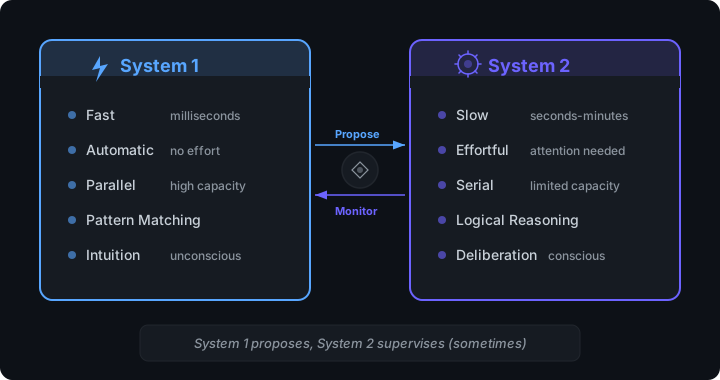
2.1 System 1 与 System 2
卡尼曼在《思考,快与慢》(2011)中系统阐述了双系统理论[1]。这一框架最早由斯坦诺维奇(Stanovich)和韦斯特(West)在 2000 年正式命名[2],但其思想根源可追溯到威廉·詹姆斯(William James)和弗洛伊德对意识层次的划分。
| 特征 | System 1(快思考) | System 2(慢思考) |
|---|---|---|
| 速度 | 极快,毫秒级 | 缓慢,需要数秒到数分钟 |
| 努力程度 | 自动,无需注意力 | 费力,消耗注意力资源 |
| 意识参与 | 无意识 | 有意识 |
| 容量 | 大规模并行 | 严格串行,容量有限 |
| 可靠性 | 多数场景高效,但存在系统性偏差 | 理论上更准确,但容易因懒惰而不被激活 |
| 典型输出 | 直觉、情感、模式识别 | 推理、计算、逻辑判断 |
| 进化起源 | 古老,与其他动物共享 | 晚近,人类特有 |
关键洞见不在于两个系统的各自特性,而在于它们的交互模式[1]:
- System 1 先行:所有感知输入首先由 System 1 处理,生成即时的直觉判断
- System 2 监督(有时):System 2 可以审核和否决 System 1 的判断,但需要消耗认知资源
- 懒惰的 System 2:在没有明确触发信号的情况下,System 2 倾向于接受 System 1 的判断——这是大多数认知偏差的来源
2.2 双过程理论的学术争论
需要指出的是,双系统理论并非毫无争议。吉仁泽(Gigerenzer)提出了一个重要的反论点[3]:所谓的「认知偏差」很多时候是「生态理性」(ecological rationality)的表现——启发式在特定环境中可以比复杂推理更有效。他的「简单启发式」(fast-and-frugal heuristics)研究表明,在不确定性高、信息不完全的环境中,少即是多(less is more)。
埃文斯(Evans, 2008)在综述中对双过程理论的多种变体做了系统梳理[4],指出学界对于「两个系统」究竟是隐喻还是真实存在的神经结构,存在根本分歧。但无论本体论地位如何,双过程框架作为设计工具的价值是清晰的——它提供了一种组织决策流水线的方式。
三、System 1 → AI 快速路径:启发式推理
3.1 启发式作为压缩算法
特沃斯基和卡尼曼在 1974 年的里程碑论文中识别出三种核心启发式[5]:
| 启发式 | 定义 | AI Agent 等价物 |
|---|---|---|
| 代表性 | 用相似度替代概率 | Few-shot prompting 中的模式匹配 |
| 可得性 | 用回忆的容易程度替代频率估计 | 检索增强生成(RAG)中的检索偏差 |
| 锚定 | 被初始值不成比例地影响 | System prompt 和 few-shot examples 的锚定效应 |
从信息论的角度看,启发式是一种有损压缩——用计算成本极低的近似替代昂贵的精确计算。这与 Simon 的有限理性理论高度一致[6]:在计算资源有限的条件下,启发式不是认知缺陷,而是最优策略。
3.2 LLM 的 System 1:前馈推理
当 LLM 直接生成响应——不使用 Chain-of-Thought、不调用工具、不进行多步推理——它本质上在执行 System 1 式操作:
- 模式匹配:基于训练数据中的统计模式生成输出
- 极低延迟:单次前馈传播,毫秒级响应
- 隐式知识:「知道」答案但无法解释推理过程
- 系统性偏差:受训练数据分布影响,对高频模式过度自信
Bengio 在 2019 年 NeurIPS 大会的讲演中明确提出了这一类比[7],后来在 Goyal 和 Bengio(2022)的论文中正式阐述[8]:当前的深度学习系统主要实现了 System 1 式的直觉推理,而 System 2 式的因果推理、组合泛化和有意识推理仍然是开放问题。
3.3 何时应该使用 System 1?
吉仁泽的研究给出了一个精确的回答[3]:当环境满足以下条件时,启发式优于复杂分析:
- 高不确定性:可用信息远少于参数数量
- 时间约束:决策窗口极短
- 稳定的统计结构:环境的底层模式不频繁变化
对 AI Agent 的启示:不是所有任务都需要 System 2。 对于格式转换、简单问答、模板填充等任务,直接的 System 1 式响应(不加 CoT、不做多步推理)可能是成本效益比最优的选择。过度使用 System 2 等价于卡尼曼所说的「计算的诅咒」——花费了大量认知资源但未显著提升决策质量。
四、System 2 → AI 慢速路径:深度推理
4.1 Chain-of-Thought 作为 System 2 的实现
Wei 等人(2022)的 Chain-of-Thought(CoT)prompting[9] 是 AI 领域对 System 2 最直接的实现:强制模型将推理过程外化为一系列中间步骤。
这与 System 2 的核心特征精确对应:
| System 2 特征 | CoT 实现 |
|---|---|
| 有意识、可报告 | 推理步骤被显式写出 |
| 串行处理 | Token 逐步生成 |
| 消耗注意力资源 | 消耗额外 token(≈计算资源) |
| 可以覆盖直觉 | 可以在推理过程中修正初始判断 |
| 容量有限 | 受 context window 长度限制 |
OpenAI 的 o 系列模型(o1, o3)和 DeepSeek-R1 将这一思路推向了极端:通过强化学习训练模型在生成最终答案之前进行大量的内部推理(reasoning tokens)。这在认知科学的术语中等价于训练 System 2 变得更自动化——将慢思考的模式内化为半自动的流程。
4.2 元认知:知道何时需要慢下来
双系统理论中一个关键但常被忽略的机制是元认知(metacognition)——System 2 监控 System 1 输出的能力。卡尼曼描述了几种触发 System 2 介入的信号[1]:
- 惊讶:System 1 的预期被违反
- 困难感:问题的表面特征暗示需要更多思考
- 高风险:决策后果的严重性超过阈值
在 AI Agent 设计中,元认知对应于路由决策(routing decision)——决定一个请求应该走快速路径还是慢速路径:
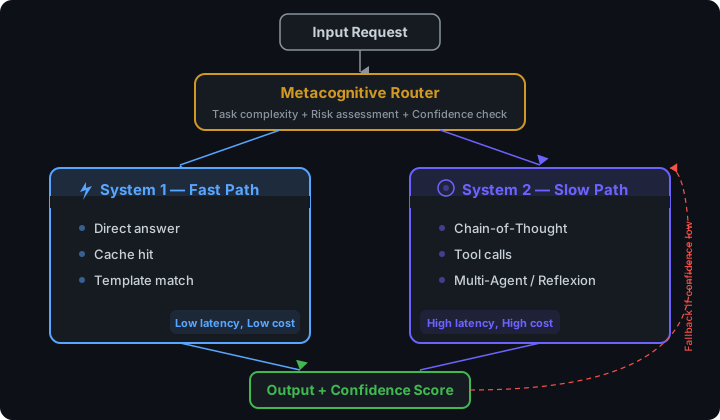
实现元认知路由器的方法包括:
- 置信度阈值:如果模型对初始响应的置信度低于阈值,触发 System 2
- 任务分类器:基于任务类型的特征自动路由
- 显式不确定性检测:检测输出中的不确定性标记(如对冲语言、矛盾陈述)
4.3 反思与自我修正
Shinn 等人(2023)的 Reflexion 框架[10] 实现了另一种 System 2 功能:从错误中学习。Agent 在执行任务后评估自己的表现,生成反思(reflection),并将反思作为下一次尝试的输入。
这与卡尼曼描述的 System 2 的「事后审计」功能相对应[1]:System 2 不仅在决策前审核 System 1 的判断,还在决策后回顾和评估决策质量——这是元认知的时间维度。
五、认知偏差作为 Agent 失败模式的分类学
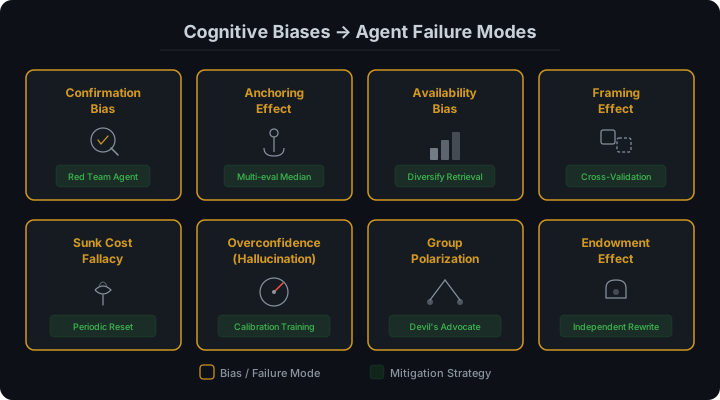
5.1 偏差即 Bug
卡尼曼和特沃斯基的最大贡献之一是识别和分类了数十种认知偏差。对 AI Agent 而言,每一种认知偏差都对应一种可预测的失败模式:
| 认知偏差 | 人类表现 | LLM Agent 表现 | 缓解策略 |
|---|---|---|---|
| 确认偏差 | 选择性搜索支持已有观点的证据 | 生成与 prompt 方向一致的内容,忽略反面证据 | 强制对立面分析(红队 Agent) |
| 锚定效应 | 被初始数值不成比例地影响 | 被 system prompt 中的示例值锚定 | 多独立评估后取中位数 |
| 可得性偏差 | 高估容易想到的事件的概率 | 过度依赖训练数据中的高频模式 | 检索多样化,显式校准 |
| 框架效应 | 同一问题的不同表述导致不同决策 | 对同一问题的不同 prompt 表述给出矛盾答案 | 多次重述问题,交叉验证 |
| 沉没成本谬误 | 因已投入的成本而继续不理性行动 | 在长 context 中坚持早期错误方向 | 定期清零重新评估 |
| 过度自信 | 对自身判断的准确性系统性高估 | 以高置信度生成错误信息(幻觉) | 校准训练,显式不确定性量化 |
| 群体极化 | 群体讨论使观点向极端移动 | 多 Agent 讨论中的正反馈循环 | 引入「魔鬼代言人」Agent |
| 禀赋效应 | 高估已拥有物品的价值 | 过度保守,不愿修改已生成的代码/文本 | 独立 Agent 从零重写,比较两个版本 |
5.2 偏差的系统性
关键洞见在于:这些偏差不是随机噪声,而是系统性的、可预测的偏离。 因此它们可以被系统性地检测和缓解——这比对抗随机错误要容易得多。
卡尼曼提出了一个重要的区分[1]:偏差(bias)vs 噪声(noise)。偏差是系统性偏离正确值,噪声是随机波动。在 AI Agent 中:
- 偏差:模型对某类问题一贯给出同一方向的错误(如高估概率、低估复杂性)
- 噪声:同一问题多次提问得到不一致的答案
不同的缓解策略针对不同类型的错误:减少偏差需要结构性干预(如换用不同视角的 Agent),减少噪声只需要重复和取平均。
六、前景理论与 Agent 决策框架
6.1 前景理论的核心发现
特沃斯基和卡尼曼(1979)的前景理论[11]揭示了人类决策中四个偏离期望效用理论的关键模式:
- 损失厌恶:损失的心理权重约为等额收益的 2 倍
- 参照依赖:效用基于相对于参照点的变化而非绝对水平
- 确定性效应:人们过度偏好确定性结果,厌恶不确定性
- 概率扭曲:小概率事件被高估,大概率事件被低估
6.2 前景理论对 Agent 决策的启示
损失厌恶 → 保守策略偏好
在 AI Agent 决策中,「损失厌恶」的等价物是对已知安全路径的过度偏好。一个经过 RLHF 训练的模型,由于训练过程中对错误输出的惩罚(负反馈)权重大于对优秀输出的奖励(正反馈),天然倾向于保守——宁可给出安全但平庸的回答,也不愿冒险给出可能出色但也可能出错的回答。
参照依赖 → Prompt 锚点效应
Agent 的决策不是在真空中进行的,而是相对于 system prompt、对话历史和当前 context 形成的「参照点」。这意味着:相同的客观任务,在不同的 prompt 框架下,会被 Agent 评估为不同难度、不同风险。
实践建议:为关键决策显式设定参照点,而非让模型从 context 中隐式推断。
确定性效应 → 过度规避不确定性
Agent 在面对两个选项时——一个确定能完成 80% 的任务,另一个有 90% 概率完成 100% 的任务——倾向于选择前者。这在需要探索性、创新性的任务中是有害的。
缓解方法:在探索阶段显式提高对不确定性的容忍度(等价于增大 temperature),在执行阶段再切换到保守策略。
七、助推架构:从行为干预到 Agent 设计模式
7.1 助推理论
塞勒(Thaler)和桑斯坦(Sunstein)在《助推》(2008)中提出了一个关键概念[12]:选择架构(choice architecture)——设计决策环境的方式会系统性地影响决策结果,即使决策者完全「自由」。
核心原则是:不限制选择自由,但通过设计默认值、信息呈现方式和反馈机制,引导决策者做出更好的选择。
7.2 Agent 选择架构的五个设计维度
| 助推原则 | 人类场景 | Agent 设计模式 |
|---|---|---|
| 默认值 | 退休金自动入会(opt-out) | Agent 的默认行为设定(如默认使用 CoT、默认验证输出) |
| 预期错误设计 | ATM 先退卡再出钞 | Agent 在关键操作前强制确认、回滚机制 |
| 映射(Mappings) | 将复杂选项转化为直觉可比较的形式 | 将抽象目标转化为具体的评估指标 |
| 反馈 | 实时油耗显示改变驾驶行为 | Agent 任务执行中的实时质量监控 |
| 结构化复杂选择 | 保险计划比较的标准化格式 | 多 Agent 方案比较的标准化评估框架 |
7.3 Prompt 作为选择架构
从行为经济学的视角看,prompt engineering 的本质就是选择架构设计——我们不是直接编程 Agent 的行为(那是传统软件),而是通过设计 Agent 的「决策环境」来间接影响其行为。
这解释了几个 prompt engineering 的经验法则:
- 为什么 few-shot examples 有效? → 锚定效应 + 代表性启发式
- 为什么 “Let’s think step by step” 有效? → 激活 System 2
- 为什么 role prompting 有效? → 改变参照框架
- 为什么负面指令(”Don’t…“)常常失效? → 讽刺监控效应(ironic process theory)[13]
八、双系统在当代 AI 架构中的实现
8.1 快慢融合架构
当前最先进的 AI Agent 架构已经隐式地实现了双系统模式:
用户请求
   │
   ▼
┌───────────────────────────────┐
│        路由器 / 元认知         │
│  (判断任务复杂度和风险等级)      │
└──────────┬────────────────────┘
           │
     ┌─────┴─────┐
     ▼           ▼
┌─────────┐ ┌──────────────────┐
│System 1 │ │    System 2       │
│快速路径  │ │    慢速路径        │
│         │ │                   │
│• 直接回答│ │• Chain-of-Thought │
│• 缓存命中│ │• 工具调用          │
│• 模板匹配│ │• 多 Agent 协商     │
│         │ │• 代码执行+验证     │
│         │ │• 反思与自我修正     │
│ 低延迟   │ │ 高延迟            │
│ 低成本   │ │ 高成本            │
└────┬────┘ └────────┬─────────┘
     │               │
     └───────┬───────┘
             ▼
     ┌──────────────┐
     │  输出 + 置信度 │
     └──────────────┘
8.2 现有实现的映射
| 系统 | System 1 实现 | System 2 实现 | 元认知/路由 |
|---|---|---|---|
| OpenAI o3 | 直接响应模式 | reasoning tokens(隐式 CoT) | 自适应计算时间 |
| Claude | 常规响应 | extended thinking mode | 模型内部判断 |
| DeepSeek-R1 | 快速推理 | 长思考链 | 训练时习得的切换策略 |
| Agent 框架 | 单步工具调用 | ReAct 循环 + Reflexion | 任务分类器 |
| RAG 系统 | 向量检索直出 | 多轮检索 + 重排序 + 验证 | 查询复杂度评估 |
8.3 Yoshua Bengio 的 System 2 研究议程
Goyal 和 Bengio(2022)在《Inductive Biases for Deep Learning of Higher-Level Cognition》中明确提出[8]:实现 AI 的 System 2 需要以下归纳偏置:
- 稀疏因子图(Sparse factor graphs)——变量之间的因果关系是稀疏的
- 动态绑定(Dynamic binding)——将符号角色与具体内容分离
- 注意力瓶颈(Attention bottleneck)——强制信息通过狭窄的有意识通道
- 因果干预(Causal intervention)——通过反事实推理理解因果关系
这些与卡尼曼对 System 2 的描述高度契合:System 2 的核心是选择性注意(注意力瓶颈)、规则应用(动态绑定)和假设检验(因果干预)。
九、设计建议:构建「行为理性」的 Agent
基于以上分析,以下是一组具体的设计建议:
9.1 实现双系统路由
不要让所有请求走同一条路径。建立一个任务复杂度评估器,根据以下信号决定路由:
- 任务类型(分类问题 vs 开放性问题)
- 风险等级(可逆操作 vs 不可逆操作)
- 所需知识类型(检索即可 vs 需要推理)
- 用户期望(速度优先 vs 质量优先)
9.2 制度化去偏差
不依赖单个 Agent 的「自律」,而是通过架构设计强制去偏差:
- 红队 Agent:专门负责寻找主 Agent 输出中的漏洞和偏差
- 多视角评估:用不同 provider 的模型(训练数据不同 → 偏差不相关)独立评估同一方案
- 预验尸分析(pre-mortem)[14]:在执行前假设方案已经失败,要求 Agent 分析可能的失败原因
9.3 设计反馈循环
没有反馈的系统无法改善。建立三个层次的反馈:
- 即时反馈:每次输出后的质量自评
- 会话反馈:任务完成后的整体反思(Reflexion)
- 跨会话反馈:将历史错误模式提炼为新的偏差校正规则
9.4 尊重 System 1
不要过度使用 System 2。对于 Agent 擅长的、低风险的、时间敏感的任务,直接使用快速路径。过度思考和思考不足一样是一种失败模式。
十、局限性与开放问题
10.1 类比的边界
双系统理论是为描述人类认知而发展的理论框架。将它应用于 AI 系统存在根本性的边界:
- LLM 没有意识:System 2 在人类中与有意识体验紧密相关。LLM 的「推理」是否与人类的 System 2 在功能上等价,仍是一个开放的哲学问题
- Transformer 不是大脑:Transformer 的注意力机制与人类的注意力在计算层面有结构性差异
- 训练 vs 发展:人类的双系统是通过漫长的进化和个体发展形成的,而 LLM 的「双系统」是通过训练工程设计的——两者的鲁棒性可能根本不同
10.2 三个开放问题
问题一:元认知路由器的最优设计是什么?
当前的路由机制大多基于启发式规则或简单的分类器。一个更根本的问题是:是否可能训练一个通用的元认知模块,能够像人类的 System 2 一样灵活地决定何时介入?
问题二:能否训练出真正去偏差的模型?
当前的去偏差策略大多是事后补救。是否可能在训练阶段就消除系统性偏差?吉仁泽会反对这个目标——他会说,在特定环境中,某些「偏差」实际上是最优策略。
问题三:双系统是否是唯一的架构?
人类认知可能不只有两个系统。斯坦诺维奇(2011)在《理性与反思性思维》中提出了三过程理论[15],增加了一个「反思性思维」(reflective mind)层——它不同于 System 2 的「算法性思维」(algorithmic mind),负责更高层次的目标设定和价值判断。如果三过程理论更准确,那么当前的 AI 架构可能还缺少一个关键层次。
十一、结语
「心理学的任务不是告诉人们他们错了,而是解释为什么他们错得如此系统、如此可预测。」 —— 丹尼尔·卡尼曼,2002 年诺贝尔奖演说
行为经济学半个世纪的研究积累,为 AI Agent 设计提供了一个被严重低估的知识宝库。双系统理论不仅仅是一个类比——它是一个经过数千项实证研究验证的决策架构框架。
当我们设计 AI Agent 的决策流水线时,应该追问的不仅是「这个算法的复杂度是多少」,还有「这个决策应该用 System 1 还是 System 2 处理?」、「我们的 Agent 容易受到哪些认知偏差的影响?」、「如何设计选择架构来引导 Agent 做出更好的决策?」
卡尼曼的遗产不是一套公式,而是一种对人类(及人工)理性极限的清醒认知——以及在这些极限内做出最好决策的方法论。
参考文献
[1] Kahneman, D. (2011). Thinking, Fast and Slow. New York: Farrar, Straus and Giroux.
[2] Stanovich, K. E. & West, R. F. (2000). “Individual Differences in Reasoning: Implications for the Rationality Debate?” Behavioral and Brain Sciences, 23(5), 645-665.
[3] Gigerenzer, G. (2007). Gut Feelings: The Intelligence of the Unconscious. New York: Viking.
[4] Evans, J. St. B. T. (2008). “Dual-Processing Accounts of Reasoning, Judgment, and Social Cognition.” Annual Review of Psychology, 59, 255-278.
[5] Tversky, A. & Kahneman, D. (1974). “Judgment under Uncertainty: Heuristics and Biases.” Science, 185(4157), 1124-1131.
[6] Simon, H. A. (1955). “A Behavioral Model of Rational Choice.” Quarterly Journal of Economics, 69(1), 99-118.
[7] Bengio, Y. (2019). “From System 1 Deep Learning to System 2 Deep Learning.” Invited talk, NeurIPS 2019.
[8] Goyal, A. & Bengio, Y. (2022). “Inductive Biases for Deep Learning of Higher-Level Cognition.” Proceedings of the Royal Society A, 478(2266), 20210068.
[9] Wei, J. et al. (2022). “Chain-of-Thought Prompting Elicits Reasoning in Large Language Models.” Advances in Neural Information Processing Systems, 35, 24824-24837.
[10] Shinn, N., Cassano, F., Gopinath, A., Narasimhan, K., & Yao, S. (2023). “Reflexion: Language Agents with Verbal Reinforcement Learning.” Advances in Neural Information Processing Systems, 36.
[11] Kahneman, D. & Tversky, A. (1979). “Prospect Theory: An Analysis of Decision under Risk.” Econometrica, 47(2), 263-292.
[12] Thaler, R. H. & Sunstein, C. R. (2008). Nudge: Improving Decisions about Health, Wealth, and Happiness. New Haven: Yale University Press.
[13] Wegner, D. M. (1994). “Ironic Processes of Mental Control.” Psychological Review, 101(1), 34-52.
[14] Klein, G. (2007). “Performing a Project Premortem.” Harvard Business Review, 85(9), 18-19.
[15] Stanovich, K. E. (2011). Rationality and the Reflective Mind. Oxford: Oxford University Press.
</small>
“Our comforting conviction that the world makes sense rests on a secure foundation: our almost unlimited ability to ignore our ignorance.” — Daniel Kahneman, Thinking, Fast and Slow
I. Introduction: The Discipline AI Engineers Overlooked
When we discuss decision-making mechanisms in AI Agents, the references come almost exclusively from computer science and artificial intelligence—reinforcement learning, search algorithms, probabilistic reasoning. Yet the most profound breakthroughs in human decision-making research over the past half century have come not from computer science, but from behavioral economics.
The research program initiated by Daniel Kahneman and Amos Tversky in the 1970s fundamentally overturned the “rational economic agent” assumption. Their core finding—that human cognitive architecture contains two fundamentally different information processing systems—has not only reshaped economics, psychology, and public policy, but holds direct, actionable implications for AI Agent architecture design.
The central argument of this essay is: Kahneman’s Dual Process Theory provides a more precise framework than traditional AI architecture literature for understanding and designing AI Agent decision pipelines. Specifically, many design challenges facing contemporary LLM Agents—when to respond quickly, when to reason deeply, how to avoid systematic biases—already have mature theoretical analyses in behavioral economics.
II. Dual-System Theory: The Core Framework of Cognitive Architecture
2.1 System 1 and System 2
Kahneman systematically articulated dual-system theory in Thinking, Fast and Slow (2011)[1]. The framework was formally named by Stanovich and West in 2000[2], though its intellectual roots trace back to William James and Freud’s stratification of consciousness.
| Feature | System 1 (Fast Thinking) | System 2 (Slow Thinking) |
|---|---|---|
| Speed | Extremely fast, milliseconds | Slow, seconds to minutes |
| Effort | Automatic, no attention needed | Effortful, consumes attentional resources |
| Consciousness | Unconscious | Conscious |
| Capacity | Massively parallel | Strictly serial, limited capacity |
| Reliability | Efficient in most scenarios, but exhibits systematic biases | Theoretically more accurate, but often not activated due to laziness |
| Typical outputs | Intuitions, emotions, pattern recognition | Reasoning, calculation, logical judgment |
| Evolutionary origin | Ancient, shared with other animals | Recent, uniquely human |
The key insight lies not in each system’s individual characteristics, but in their interaction patterns[1]:
- System 1 goes first: All perceptual input is first processed by System 1, generating immediate intuitive judgments
- System 2 supervises (sometimes): System 2 can review and override System 1’s judgments, but this requires cognitive resources
- The lazy System 2: Without an explicit trigger, System 2 tends to accept System 1’s judgments—this is the source of most cognitive biases
2.2 Academic Debates on Dual Process Theory
It must be noted that dual-system theory is not without controversy. Gigerenzer raised an important counterargument[3]: many so-called “cognitive biases” are actually manifestations of “ecological rationality”—heuristics that can be more effective than complex reasoning in specific environments. His “fast-and-frugal heuristics” research demonstrates that in environments with high uncertainty and incomplete information, less is more.
Evans (2008) provided a systematic survey of the multiple variants of dual-process theory[4], noting a fundamental disagreement in the field over whether the “two systems” are merely metaphors or real neural structures. Regardless of their ontological status, the value of the dual-process framework as a design tool is clear—it provides a way to organize decision pipelines.
III. System 1 → AI Fast Path: Heuristic Reasoning
3.1 Heuristics as Compression Algorithms
Tversky and Kahneman identified three core heuristics in their landmark 1974 paper[5]:
| Heuristic | Definition | AI Agent Equivalent |
|---|---|---|
| Representativeness | Substituting similarity for probability | Pattern matching in few-shot prompting |
| Availability | Substituting ease of recall for frequency estimation | Retrieval bias in RAG systems |
| Anchoring | Disproportionate influence by initial values | Anchoring effects from system prompts and few-shot examples |
From an information-theoretic perspective, heuristics are a form of lossy compression—replacing expensive exact computation with computationally cheap approximations. This is highly consistent with Simon’s bounded rationality theory[6]: under limited computational resources, heuristics are not cognitive defects but optimal strategies.
3.2 The LLM’s System 1: Feedforward Reasoning
When an LLM directly generates a response—without Chain-of-Thought, without tool calls, without multi-step reasoning—it is essentially performing a System 1 operation:
- Pattern matching: Generating output based on statistical patterns in training data
- Ultra-low latency: Single forward pass, millisecond response
- Implicit knowledge: “Knows” the answer but cannot explain the reasoning process
- Systematic biases: Influenced by training data distribution, overconfident on high-frequency patterns
Bengio explicitly proposed this analogy in his 2019 NeurIPS keynote[7], later formally elaborated in Goyal and Bengio (2022)[8]: current deep learning systems primarily implement System 1-style intuitive reasoning, while System 2-style causal reasoning, compositional generalization, and conscious reasoning remain open problems.
3.3 When Should System 1 Be Used?
Gigerenzer’s research provides a precise answer[3]: heuristics outperform complex analysis when the environment meets these conditions:
- High uncertainty: Available information is far less than the number of parameters
- Time constraints: Decision window is extremely short
- Stable statistical structure: The underlying patterns of the environment do not change frequently
The implication for AI Agents: Not all tasks require System 2. For format conversion, simple Q&A, template filling, and similar tasks, direct System 1-style responses (without CoT, without multi-step reasoning) may offer the best cost-benefit ratio. Overusing System 2 is equivalent to what Kahneman calls “the curse of computation”—expending vast cognitive resources without significantly improving decision quality.
IV. System 2 → AI Slow Path: Deep Reasoning
4.1 Chain-of-Thought as a System 2 Implementation
Wei et al.’s (2022) Chain-of-Thought (CoT) prompting[9] is the most direct AI implementation of System 2: forcing the model to externalize its reasoning process as a series of intermediate steps.
This precisely corresponds to System 2’s core features:
| System 2 Feature | CoT Implementation |
|---|---|
| Conscious, reportable | Reasoning steps explicitly written out |
| Serial processing | Tokens generated sequentially |
| Consumes attentional resources | Consumes additional tokens (≈ computational resources) |
| Can override intuition | Can correct initial judgments during reasoning |
| Limited capacity | Constrained by context window length |
OpenAI’s o-series models (o1, o3) and DeepSeek-R1 push this approach to extremes: using reinforcement learning to train models to conduct extensive internal reasoning (reasoning tokens) before generating final answers. In cognitive science terms, this is equivalent to training System 2 to become more automated—internalizing slow thinking patterns into semi-automatic processes.
4.2 Metacognition: Knowing When to Slow Down
A key but often overlooked mechanism in dual-system theory is metacognition—System 2’s ability to monitor System 1 output. Kahneman described several signals that trigger System 2 intervention[1]:
- Surprise: System 1’s expectations are violated
- Sense of difficulty: Surface features of the problem signal the need for more thought
- High stakes: The severity of decision consequences exceeds a threshold
In AI Agent design, metacognition corresponds to routing decisions—determining whether a request should take the fast path or the slow path:
Methods for implementing metacognitive routers include:
- Confidence thresholds: Trigger System 2 if the model’s confidence in its initial response falls below a threshold
- Task classifiers: Automatic routing based on task type features
- Explicit uncertainty detection: Detecting uncertainty markers in output (hedging language, contradictory statements)
4.3 Reflection and Self-Correction
Shinn et al.’s (2023) Reflexion framework[10] implements another System 2 function: learning from mistakes. The agent evaluates its own performance after executing a task, generates reflections, and uses those reflections as input for the next attempt.
This corresponds to Kahneman’s description of System 2’s “post-hoc audit” function[1]: System 2 not only reviews System 1’s judgments before decisions, but also reviews and evaluates decision quality after the fact—this is the temporal dimension of metacognition.
V. Cognitive Biases as an Agent Failure Mode Taxonomy
5.1 Biases as Bugs
One of Kahneman and Tversky’s greatest contributions was identifying and classifying dozens of cognitive biases. For AI Agents, each cognitive bias corresponds to a predictable failure mode:
| Cognitive Bias | Human Manifestation | LLM Agent Manifestation | Mitigation Strategy |
|---|---|---|---|
| Confirmation bias | Selectively seeking evidence supporting existing beliefs | Generating content aligned with prompt direction, ignoring counterevidence | Forced adversarial analysis (red team Agent) |
| Anchoring effect | Disproportionate influence by initial values | Anchored by example values in system prompts | Multiple independent evaluations, take median |
| Availability bias | Overestimating probability of easily recalled events | Over-reliance on high-frequency patterns in training data | Retrieval diversification, explicit calibration |
| Framing effect | Different framings of the same problem lead to different decisions | Contradictory answers to differently phrased versions of the same question | Multiple reframings, cross-validation |
| Sunk cost fallacy | Continuing irrational actions due to prior investment | Persisting with early wrong directions in long contexts | Periodic reset and re-evaluation |
| Overconfidence | Systematic overestimation of one’s judgment accuracy | Generating incorrect information with high confidence (hallucination) | Calibration training, explicit uncertainty quantification |
| Group polarization | Group discussion shifts opinions toward extremes | Positive feedback loops in multi-Agent discussions | Introduce a “devil’s advocate” Agent |
| Endowment effect | Overvaluing already-possessed items | Excessive conservatism, reluctance to modify generated code/text | Independent Agent rewrites from scratch, compare versions |
5.2 The Systematic Nature of Biases
The key insight is: these biases are not random noise, but systematic, predictable deviations. Therefore they can be systematically detected and mitigated—which is far easier than combating random errors.
Kahneman drew an important distinction[1]: bias vs. noise. Bias is systematic deviation from the correct value; noise is random fluctuation. In AI Agents:
- Bias: The model consistently errs in the same direction for certain types of problems (e.g., overestimating probabilities, underestimating complexity)
- Noise: The same question asked multiple times yields inconsistent answers
Different mitigation strategies target different error types: reducing bias requires structural intervention (e.g., using Agents with different perspectives), while reducing noise only requires repetition and averaging.
VI. Prospect Theory and Agent Decision Frameworks
6.1 Core Findings of Prospect Theory
Kahneman and Tversky’s (1979) prospect theory[11] revealed four key departures from expected utility theory in human decision-making:
- Loss aversion: The psychological weight of losses is approximately 2x that of equivalent gains
- Reference dependence: Utility is based on changes relative to a reference point, not absolute levels
- Certainty effect: People disproportionately prefer certain outcomes and are averse to uncertainty
- Probability distortion: Small probabilities are overweighted, large probabilities are underweighted
6.2 Prospect Theory’s Implications for Agent Decisions
Loss Aversion → Conservative Strategy Preference
In AI Agent decision-making, the equivalent of “loss aversion” is excessive preference for known safe paths. A model trained with RLHF, due to the training process weighting punishment for incorrect outputs (negative feedback) more heavily than rewards for excellent outputs (positive feedback), naturally tends toward conservatism—preferring safe but mediocre answers over potentially brilliant but possibly erroneous ones.
Reference Dependence → Prompt Anchor Effects
Agent decisions do not occur in a vacuum but relative to “reference points” formed by system prompts, conversation history, and current context. This means: the same objective task, under different prompt framings, will be evaluated by the Agent as having different difficulty and risk levels.
Practical recommendation: Explicitly set reference points for critical decisions rather than letting the model implicitly infer them from context.
Certainty Effect → Excessive Uncertainty Avoidance
When an Agent faces two options—one that can definitely complete 80% of a task, and another with a 90% probability of completing 100%—it tends to choose the former. This is harmful for tasks requiring exploration and innovation.
Mitigation: Explicitly increase tolerance for uncertainty during exploration phases (equivalent to increasing temperature), then switch to conservative strategies during execution phases.
VII. Nudge Architecture: From Behavioral Intervention to Agent Design Patterns
7.1 Nudge Theory
Thaler and Sunstein proposed a key concept in Nudge (2008)[12]: choice architecture—the way decision environments are designed systematically influences decision outcomes, even when decision-makers are completely “free.”
The core principle: do not restrict choice freedom, but guide decision-makers toward better choices through the design of defaults, information presentation, and feedback mechanisms.
7.2 Five Design Dimensions of Agent Choice Architecture
| Nudge Principle | Human Scenario | Agent Design Pattern |
|---|---|---|
| Defaults | Automatic retirement plan enrollment (opt-out) | Agent default behaviors (e.g., default CoT, default output validation) |
| Design for error | ATM returns card before dispensing cash | Mandatory confirmation before critical operations, rollback mechanisms |
| Mappings | Translating complex options into intuitively comparable forms | Converting abstract goals into concrete evaluation metrics |
| Feedback | Real-time fuel consumption display changes driving behavior | Real-time quality monitoring during Agent task execution |
| Structure complex choices | Standardized format for insurance plan comparison | Standardized evaluation framework for multi-Agent solution comparison |
7.3 Prompts as Choice Architecture
From a behavioral economics perspective, the essence of prompt engineering is choice architecture design—we are not directly programming Agent behavior (that would be traditional software), but indirectly influencing its behavior by designing the Agent’s “decision environment.”
This explains several prompt engineering rules of thumb:
- Why do few-shot examples work? → Anchoring effect + representativeness heuristic
- Why does “Let’s think step by step” work? → Activates System 2
- Why does role prompting work? → Changes the reference frame
- Why do negative instructions (“Don’t…”) often fail? → Ironic process theory[13]
VIII. Dual Systems in Contemporary AI Architecture
8.1 Fast-Slow Fusion Architecture
The most advanced current AI Agent architectures have implicitly implemented the dual-system pattern:
User Request
   │
   ▼
┌───────────────────────────────┐
│     Router / Metacognition     │
│  (Assess task complexity       │
│   and risk level)              │
└──────────┬────────────────────┘
           │
     ┌─────┴─────┐
     ▼           ▼
┌─────────┐ ┌──────────────────┐
│System 1 │ │    System 2       │
│Fast Path│ │    Slow Path      │
│         │ │                   │
│• Direct │ │• Chain-of-Thought │
│  answer │ │• Tool calls       │
│• Cache  │ │• Multi-Agent      │
│  hit    │ │  negotiation      │
│• Templ. │ │• Code exec+verify │
│  match  │ │• Reflect & self-  │
│         │ │  correct          │
│Low      │ │High               │
│latency  │ │latency            │
│Low cost │ │High cost          │
└────┬────┘ └────────┬─────────┘
     │               │
     └───────┬───────┘
             ▼
     ┌──────────────┐
     │Output +       │
     │Confidence     │
     └──────────────┘
8.2 Mapping of Existing Implementations
| System | System 1 Implementation | System 2 Implementation | Metacognition/Routing |
|---|---|---|---|
| OpenAI o3 | Direct response mode | Reasoning tokens (implicit CoT) | Adaptive compute time |
| Claude | Standard response | Extended thinking mode | Internal model judgment |
| DeepSeek-R1 | Fast inference | Long chains of thought | Switching strategy learned during training |
| Agent frameworks | Single-step tool calls | ReAct loops + Reflexion | Task classifier |
| RAG systems | Vector retrieval direct output | Multi-round retrieval + reranking + verification | Query complexity assessment |
8.3 Yoshua Bengio’s System 2 Research Agenda
Goyal and Bengio (2022) explicitly proposed in Inductive Biases for Deep Learning of Higher-Level Cognition[8] that implementing AI’s System 2 requires the following inductive biases:
- Sparse factor graphs — Causal relationships between variables are sparse
- Dynamic binding — Separating symbolic roles from specific content
- Attention bottleneck — Forcing information through a narrow conscious channel
- Causal intervention — Understanding causality through counterfactual reasoning
These correspond closely to Kahneman’s description of System 2: its core is selective attention (attention bottleneck), rule application (dynamic binding), and hypothesis testing (causal intervention).
IX. Design Recommendations: Building “Behaviorally Rational” Agents
Based on the above analysis, here is a set of concrete design recommendations:
9.1 Implement Dual-System Routing
Do not let all requests take the same path. Build a task complexity assessor that makes routing decisions based on:
- Task type (classification problem vs. open-ended question)
- Risk level (reversible operation vs. irreversible operation)
- Required knowledge type (retrieval sufficient vs. reasoning needed)
- User expectations (speed priority vs. quality priority)
9.2 Institutionalize Debiasing
Do not rely on a single Agent’s “self-discipline”; instead, force debiasing through architectural design:
- Red team Agent: Specifically responsible for finding vulnerabilities and biases in the main Agent’s output
- Multi-perspective evaluation: Use models from different providers (different training data → uncorrelated biases) to independently evaluate the same proposal
- Pre-mortem analysis[14]: Before execution, assume the plan has already failed and require the Agent to analyze possible causes of failure
9.3 Design Feedback Loops
Systems without feedback cannot improve. Establish three levels of feedback:
- Immediate feedback: Quality self-assessment after each output
- Session feedback: Overall reflection after task completion (Reflexion)
- Cross-session feedback: Distill historical error patterns into new bias correction rules
9.4 Respect System 1
Do not overuse System 2. For tasks the Agent excels at, that are low-risk, and that are time-sensitive, use the fast path directly. Overthinking is just as much a failure mode as underthinking.
X. Limitations and Open Questions
10.1 Boundaries of the Analogy
Dual-system theory was developed as a theoretical framework for describing human cognition. Applying it to AI systems has fundamental boundaries:
- LLMs lack consciousness: System 2 in humans is intimately related to conscious experience. Whether LLM “reasoning” is functionally equivalent to human System 2 remains an open philosophical question
- Transformers are not brains: The Transformer’s attention mechanism differs structurally from human attention at the computational level
- Training vs. development: The human dual system formed through lengthy evolution and individual development, while the LLM’s “dual system” is engineered through training—their robustness may be fundamentally different
10.2 Three Open Questions
Question 1: What is the optimal design for metacognitive routers?
Current routing mechanisms are mostly based on heuristic rules or simple classifiers. A more fundamental question is: is it possible to train a general metacognitive module that can flexibly decide when to intervene, like human System 2?
Question 2: Can we train truly debiased models?
Current debiasing strategies are mostly post-hoc remedies. Is it possible to eliminate systematic biases during the training phase itself? Gigerenzer would object to this goal—he would argue that in specific environments, certain “biases” are actually optimal strategies.
Question 3: Is the dual system the only architecture?
Human cognition may have more than two systems. Stanovich (2011) proposed a tri-process theory in Rationality and the Reflective Mind[15], adding a “reflective mind” layer distinct from System 2’s “algorithmic mind”—responsible for higher-level goal-setting and value judgment. If tri-process theory is more accurate, current AI architectures may still be missing a critical layer.
XI. Conclusion
“The premise of this book is that it is easier to recognize other people’s mistakes than our own.” — Daniel Kahneman, Thinking, Fast and Slow
Half a century of behavioral economics research offers a severely underestimated knowledge treasury for AI Agent design. Dual-system theory is not merely an analogy—it is a decision architecture framework validated by thousands of empirical studies.
When designing AI Agent decision pipelines, we should ask not only “What is the computational complexity of this algorithm?” but also “Should this decision be processed by System 1 or System 2?”, “What cognitive biases is our Agent susceptible to?”, and “How can we design choice architecture to guide the Agent toward better decisions?”
Kahneman’s legacy is not a set of formulas, but a lucid awareness of the limits of human (and artificial) rationality—and a methodology for making the best decisions within those limits.
References
[1] Kahneman, D. (2011). Thinking, Fast and Slow. New York: Farrar, Straus and Giroux.
[2] Stanovich, K. E. & West, R. F. (2000). “Individual Differences in Reasoning: Implications for the Rationality Debate?” Behavioral and Brain Sciences, 23(5), 645-665.
[3] Gigerenzer, G. (2007). Gut Feelings: The Intelligence of the Unconscious. New York: Viking.
[4] Evans, J. St. B. T. (2008). “Dual-Processing Accounts of Reasoning, Judgment, and Social Cognition.” Annual Review of Psychology, 59, 255-278.
[5] Tversky, A. & Kahneman, D. (1974). “Judgment under Uncertainty: Heuristics and Biases.” Science, 185(4157), 1124-1131.
[6] Simon, H. A. (1955). “A Behavioral Model of Rational Choice.” Quarterly Journal of Economics, 69(1), 99-118.
[7] Bengio, Y. (2019). “From System 1 Deep Learning to System 2 Deep Learning.” Invited talk, NeurIPS 2019.
[8] Goyal, A. & Bengio, Y. (2022). “Inductive Biases for Deep Learning of Higher-Level Cognition.” Proceedings of the Royal Society A, 478(2266), 20210068.
[9] Wei, J. et al. (2022). “Chain-of-Thought Prompting Elicits Reasoning in Large Language Models.” Advances in Neural Information Processing Systems, 35, 24824-24837.
[10] Shinn, N., Cassano, F., Gopinath, A., Narasimhan, K., & Yao, S. (2023). “Reflexion: Language Agents with Verbal Reinforcement Learning.” Advances in Neural Information Processing Systems, 36.
[11] Kahneman, D. & Tversky, A. (1979). “Prospect Theory: An Analysis of Decision under Risk.” Econometrica, 47(2), 263-292.
[12] Thaler, R. H. & Sunstein, C. R. (2008). Nudge: Improving Decisions about Health, Wealth, and Happiness. New Haven: Yale University Press.
[13] Wegner, D. M. (1994). “Ironic Processes of Mental Control.” Psychological Review, 101(1), 34-52.
[14] Klein, G. (2007). “Performing a Project Premortem.” Harvard Business Review, 85(9), 18-19.
[15] Stanovich, K. E. (2011). Rationality and the Reflective Mind. Oxford: Oxford University Press.
</small>